

Request a Sample Itinerary
We will send you a sample itinerary which you can further customize as you wish. We will never sell or share your email address with anyone else.
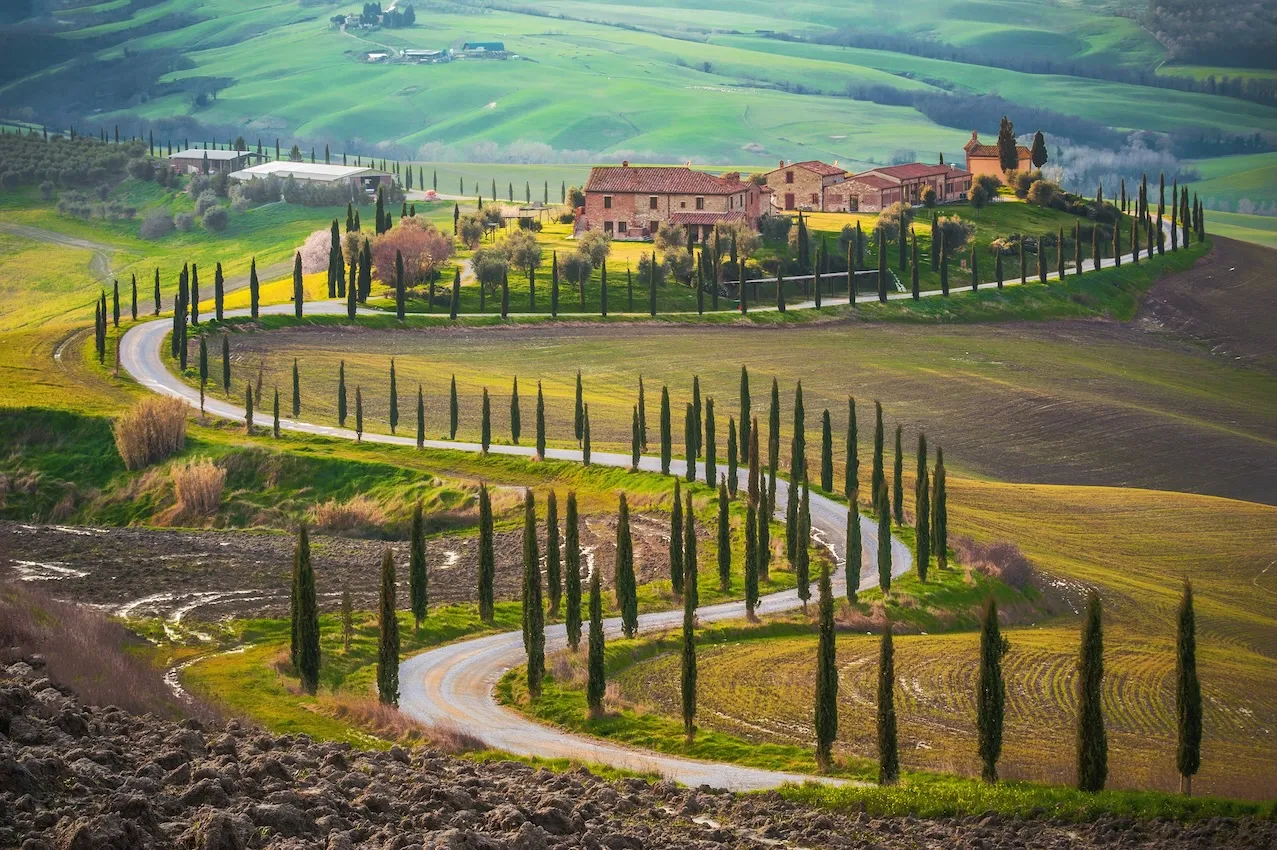
Cycling Tuscany: Cypress Trees, Sangiovese, and the Art of Slowing Down
Some regions ask to be seen quickly. Tuscany asks the opposite. This is a landscape built for lingering — for pausing halfway up a hill to look back at a cypress-lined driveway, for stopping in a hilltop town because the view demands it, for ordering one more glass of Chianti because dinner clearly isn't over yet. A cycling tour through Tuscany moves at exactly the pace this region deserves, threading together medieval hilltop towns, centuries-old vineyards, and some of the most photographed countryside on earth.
A typical route through the region links towns like Radda in Chianti, San Gimignano, Sovicille, Asciano, Montalcino, and Montepulciano, with Siena and Florence often serving as bookend cities. Along the way, riders pass through the heart of Chianti, along the edge of the UNESCO-listed Val d'Orcia, and through small towns that have barely changed their skylines in five hundred years.
A Landscape Made for Riding Slowly
Tuscany sits comfortably in the sweet spot for cycling from May through October, when temperatures are pleasantly warm and rainfall is less likely. Spring and fall are considered ideal riding conditions, while July and August bring the heat of high summer, tempered somewhat by a pleasant breeze. Rain risk climbs again in late October and November, and winter touring isn't recommended at all.
What makes the region so distinctive on a bike isn't just the weather, though — it's the terrain and the texture of the roads themselves. Tuscany is famous for its Strade Bianche, or "white roads": unpaved gravel paths that wind through cypress-lined avenues, forests, olive orchards, and vineyards. Originally used by farmers and travelers, these historic routes now host the prestigious Strade Bianche professional cycling race, which starts and finishes in Siena and has become one of the most celebrated events in modern cycling. The race draws direct inspiration from L'Eroica, a vintage cycling event where riders don period attire and ride classic steel-framed bikes complete with toe-strap pedals and down-tube gear levers, following routes past medieval villages, castles, and Tuscan farmhouses in a celebration of the sport's golden age. L'Eroica starts and ends in the village of Gaiole, near Radda.
Hilltop Towns Worth the Climb
Tuscany's hill towns are the region's signature feature, and each has its own personality:
- Radda in Chianti — A charming hilltop hub for Chianti Classico wine, with medieval streets and panoramic views across vineyards from the town walls.
- San Gimignano — Once a key stop on the Via Francigena pilgrimage route, this UNESCO World Heritage site is famous for its cluster of medieval stone towers, which have earned it the nickname "the Manhattan of Tuscany."
- Volterra — A stark, imposing town perched on a rocky outcrop, often described as an inland island, with visible ruins dating back to both the Etruscans and the Romans.
- Asciano — Tucked into the Crete Senesi south of Siena, Asciano offers a more authentic, less touristy Tuscan experience, layered with medieval charm and both Etruscan and Roman history.
- Montalcino — A picturesque hilltop town surrounded by vineyards, home to Brunello di Montalcino wine, with a medieval fortress, historic churches, and sweeping countryside views.
- Montepulciano — Renowned for Vino Nobile di Montepulciano wine, this hill town features Renaissance palaces, a grand central piazza, and winding medieval streets.
Nearby, Castello di Brolio claims a particularly deep pedigree: it's the birthplace of Chianti Classico, and the Ricasoli family has been making wine there since 1141 — nearly nine centuries of continuous production on the same estate.
And then there's the Val d'Orcia, a UNESCO World Heritage Site famous for its rolling hills and cypress-lined avenues — the exact image most people picture when they hear the word "Tuscany," and a landscape that has inspired painters and photographers for centuries.
A History Layered Like the Landscape
Tuscany takes its name from the Etruscans, the region's pre-Roman inhabitants, though it was the Romans who governed the land for centuries afterward. The Etruscan civilization, which flourished from roughly the 7th to the 6th century BCE, excelled in agriculture, mining, and art, building cities like Volterra and Cortona along with extensive trade networks and roads. Roman dominance followed from 509 BCE onward, and under the empire, the region — then called Etruria — became a key territory, with cities like Florentia (Florence) growing into major trade and administrative centers.
The fall of the Western Roman Empire in 476 CE ushered in a period of invasions by Goths, Lombards, and other Germanic tribes, before Charlemagne conquered the Lombards in 774 CE and folded Tuscany into the Holy Roman Empire. By the 11th century, major towns including Florence, Siena, and Pisa had developed into independent, wealthy city-states, their rivalries shaping Tuscan politics for the next three centuries as trade and banking fueled a cultural flowering in art, literature, and architecture.
The Black Death struck in 1348, killing almost half the region's population and disrupting its economic and social fabric. Yet Tuscany's most defining era arrived not long after: in the 15th century, Florence — under the Medici family — became the beating heart of the Renaissance, home to towering cultural figures including Leonardo da Vinci, Michelangelo, and Dante Alighieri. Siena remained Florence's chief rival until its defeat in 1555, after which Tuscany was unified under Medici rule in 1559, ending centuries of city-state competition.
The Medici dynasty ended in 1737, giving way to Habsburg-Lorraine governance and a wave of agricultural and infrastructural modernization. Tuscany joined the newly unified Kingdom of Italy in 1860, and Florence briefly served as the nation's capital in 1865 before Rome took over permanently in 1871. The 20th century brought its share of upheaval — World War I strain, the rise of fascism under Mussolini, and Nazi occupation during World War II, when partisan fighters played a crucial role in liberating cities like Florence and Siena, often at great cost to the region's historic buildings and bridges.
Post-war reconstruction restored much of Tuscany's cultural heritage, though a catastrophic flood of the Arno River in 1966 devastated Florence, damaging priceless Renaissance art and manuscripts and prompting a massive international restoration effort. In 1982, Florence's historic center was recognized as a UNESCO World Heritage Site, alongside other Tuscan treasures like San Gimignano, Siena, and Val d'Orcia. In the decades since, Tuscany has solidified its place as a global cultural and tourism hub, with investment in wine production — especially Chianti and Brunello — continuing to drive the region's economy today.
Eating Like a Local
Tuscan cuisine is built on fresh, seasonal, locally sourced ingredients, rooted firmly in the Mediterranean diet and centered on fruits, vegetables, legumes, cheeses, and pasta. The true cornerstone, though, is olive oil — pure and locally pressed, forming the backbone of countless dishes. Flavor profiles shift with geography: coastal areas produce lighter, golden oils, the central Chianti region yields oils with peppery, artichoke notes and a greenish tint, and oils from around Montalcino in the south tend toward intense, rustic, deeply colored flavors.
Beans hold a special place in Tuscan food culture — so much so that locals are affectionately nicknamed mangiafagioli, or "bean eaters," with cannellini beans a particular favorite. Sage and rosemary dominate the herb rack, joined by basil, fennel, and thyme, while locally cured meats and cheeses round out the pantry.
A few dishes are worth specifically seeking out:
- Pici — Hand-rolled, thick spaghetti, often served with aglione (garlic and tomato) sauce or a rich wild boar ragù.
- Pappardelle al cinghiale — Wide noodles paired with wild boar sauce, a dish that captures Tuscany's deep affinity for the countryside.
- Cinghiale in umido — A hearty wild boar stew simmered with red wine, tomatoes, garlic, and vegetables, traditionally served over creamy polenta. The wild boar holds near-mythic status in Tuscan culture; in Florence, visitors still rub the nose of "Il Porcellino," a bronze boar statue, for good luck.
- Tartufi (truffles) — A prized, pricy delicacy, with white truffles shaved raw over pasta, risotto, and eggs, and black truffles worked into sauces, meats, and infused oils.
The Wines: Sangiovese, Three Ways
Tuscany's wine reputation rests largely on what's sometimes called the Sangiovese trio — Chianti, Brunello di Montalcino, and Vino Nobile di Montepulciano — a testament to just how much character one grape variety can express across different corners of the same region. Tuscany produces only about 5% of Italy's wine by volume, yet accounts for over 10% of its value, a clear signal of the quality packed into every bottle. With more than 1,000 vineyards, 42 DOCs, and 11 DOCGs (Italy's strictest quality designation), the region rewards close attention.
- Brunello di Montalcino — One of Italy's most prestigious and expensive wines, made from 100% Sangiovese grapes grown around Montalcino. Once thought to be a distinct grape variety, "Brunello" was identified as Sangiovese in 1879; the modern style was pioneered in the late 19th century by Ferruccio Biondi-Santi, whose winery still operates today. Full-bodied and complex, with flavors of cherry, plum, tobacco, and herbs, some bottles are said to age gracefully for over a century. In 1980, Brunello became the first Italian wine to earn DOCG status.
- Chianti Classico — With roots stretching to the 13th century (when, curiously, early versions were white wine), Chianti evolved into a red blend after Baron Bettino Ricasoli devised the first modern "Chianti recipe" in 1872. Quality dipped in the mid-20th century, when the wine became associated with cheap straw-wrapped fiasco bottles, but Chianti Classico — particularly the Riserva style, aged at least 24 months — has reclaimed its place among Italy's great wines.
- Vernaccia di San Gimignano — A crisp, dry white with a slightly bitter finish, first documented in 1276 and revered since the Renaissance. It was the first Italian wine to receive DOC status, in 1966, and DOCG status followed in 1993.
- Vino Nobile di Montepulciano — A dry, full-bodied red made primarily from Sangiovese (locally called Prugnolo gentile), with flavors of cherry, forest fruit, violet, and vanilla. Once celebrated as one of Italy's finest wines in the Middle Ages, it lost ground to Brunello, Barolo, and Amarone before a recent resurgence in quality restored its standing.
One statistic offers a nice sense of scale: a single acre of Tuscan vineyard can yield roughly 5 tons of grapes — enough for about 4,000 bottles, or roughly 16,000 glasses, of wine.
Local Color: Horses, Roosters, and Leather
A handful of Tuscan traditions round out the picture, and they tend to come up in conversation whether you go looking for them or not.
The Palio di Siena, held every July 2nd and August 16th, is one of Italy's most electrifying spectacles: a bareback horse race around the Piazza del Campo, contested by ten riders representing ten of Siena's seventeen historic city districts, or contrade. Months of preparation and centuries of fierce inter-district rivalry culminate in a race that lasts barely ninety seconds — the city spends far longer decorating its streets with flags and celebrating beforehand than the race itself takes to run.
The Italian language itself has Tuscan roots. While official documents in the Renaissance were typically written in Latin, the Florentine poet Dante Alighieri wrote his Divine Comedy in the Florentine dialect — a choice that helped establish that dialect as the foundation of modern standard Italian.
Wine bottles throughout Chianti carry the emblem of the Gallo Nero, or black rooster — a symbol tracing back to a medieval legend about Florence and Siena settling a border dispute with a rooster-crowing contest. As the story goes, the Sienese pampered their white rooster while the Florentines deliberately starved their black one; on the day of the contest, the hungry black rooster crowed well before dawn, giving the Florentine rider a head start that shifted the border decisively in Florence's favor.
Tuscany is also a major player in Italian leather production, accounting for roughly a third of the country's output, centered around Santa Croce dell'Arno between Florence and Pisa — with Florence itself particularly celebrated for the quality of its finished leather goods.
Getting There
Tuscan cycling tours typically begin in Siena or Florence, though many travelers first fly into Rome. From Rome's Fiumicino Airport, the Leonardo Express train reaches Roma Termini in about 30 minutes, connecting to a Trenitalia service to Florence's Santa Maria Novella station in roughly 90 minutes. Travelers flying directly into Florence's smaller Peretola airport can reach the city center by tram in about 5 to 10 minutes, or by a fixed-fare regulated taxi. From Florence, both trains and buses run regularly to Siena, each taking about 90 minutes.
Why Tuscany Rewards Patience
What makes Tuscany such a natural match for cycling isn't speed — it's the opposite. This is a region where the pleasures are cumulative: a hilltop town glimpsed from a distance becomes worth the climb once you're close enough to see its towers properly; a glass of Chianti tastes better after a morning spent riding past the vineyards that produced it; a plate of pici with wild boar ragù makes more sense after a day spent among the forests where the boar actually live.
A car moves you between Tuscany's highlights. A bicycle moves you through the region itself — past the cypress trees, along the white gravel roads, and into the kind of unhurried, sensory experience that Tuscany has spent centuries perfecting.
Ready to plan your tour?
Tell us where you want to go and how you want to ride. We'll send you an itinerary.