

Request a Sample Itinerary
We will send you a sample itinerary which you can further customize as you wish. We will never sell or share your email address with anyone else.
# Planning a Cycling Trip to Southwest Ireland: What to Know Before You Go
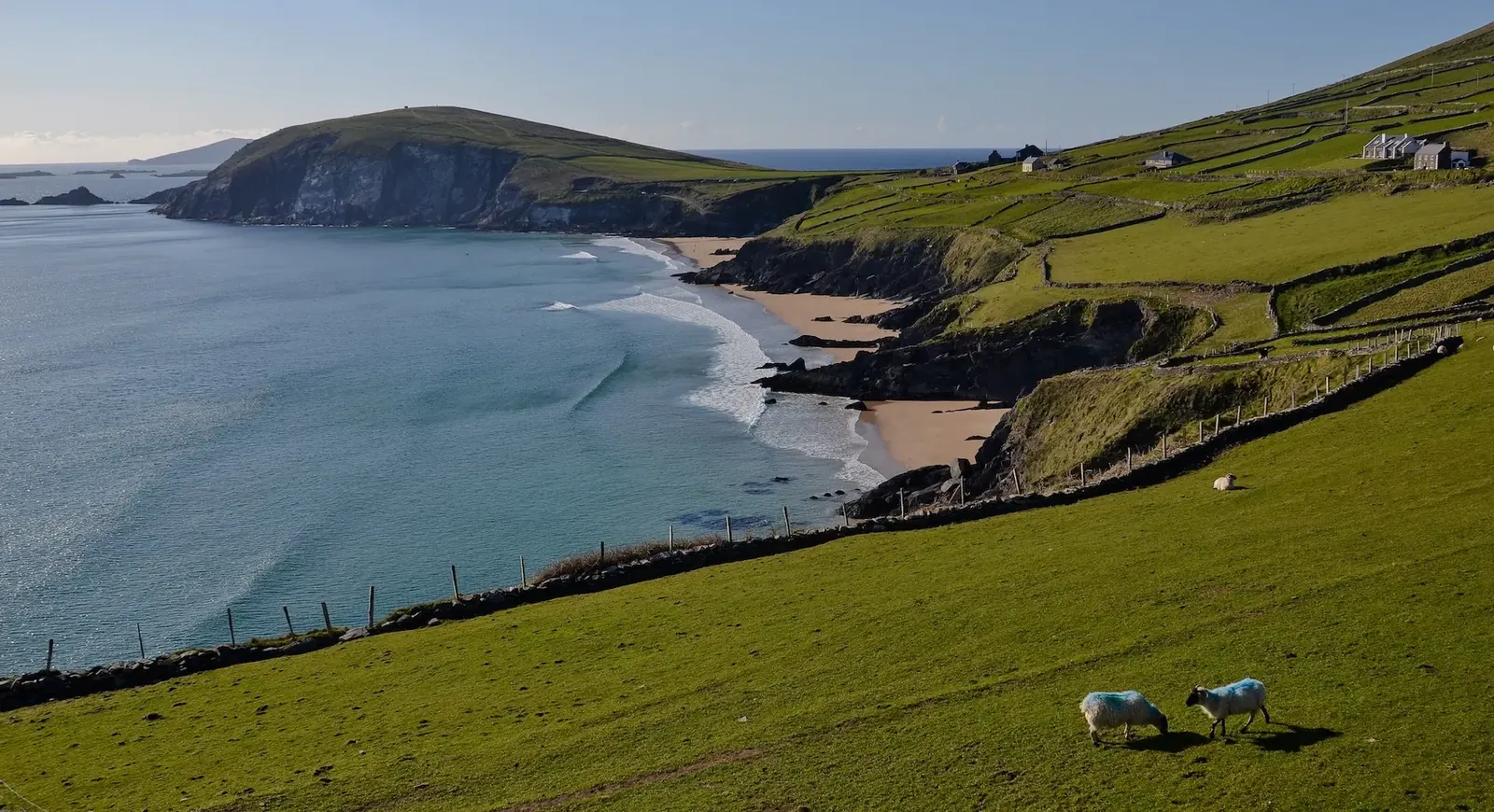
Southwest Ireland has a way of getting under your skin. Along the coast, Atlantic rollers crash into towering cliffs, while sheltered harbors and white-sand beaches break up the drama. Inland, emerald farmland rolls on for miles, framed by hedgerows and ancient stone walls. And everywhere you go, there's a warmth to the welcome — a genuine, unhurried friendliness that turns a short chat at a pub into one of the best parts of your trip.
For cyclists, this corner of County Kerry — centered on Dingle, Killarney, and Kenmare — is about as good as it gets: quiet lanes, dramatic mountain passes, and a culture built around food, music, and conversation. If you're planning a trip, here's what you actually need to know before you land.
## Getting There and Getting Started
Most international flights into Ireland land in Dublin, with connections available from major cities across Europe and a handful of North American hubs including Boston, Chicago, Los Angeles, New York, and Toronto. From Dublin, taxis into the city center run roughly €25–€30 and take about half an hour, while express buses cost around €10 per person.
If you'd rather skip Dublin altogether, Shannon Airport near Limerick is a smaller but well-connected option, with direct flights from a number of European cities and a few US airports.
From Dublin, regular train service connects to Tralee and Killarney — the typical jumping-off points for a Kerry cycling tour — with several morning departures that get you into the region by early afternoon.
## Where to Stay Before Your Ride
Most cyclists spend a night in Tralee, Killarney, or Limerick before starting their route, giving themselves time to adjust and settle in. All three towns have a solid range of hotels and B&Bs within easy reach of the train stations, so there's no need to overthink pre-trip logistics — just pick a base that lines up with your route's starting point.
## What to Pack (and What You Can Skip)
Ireland's weather is famously changeable — mild, moist, and prone to switching between sun and rain within the same afternoon — so waterproof layers are non-negotiable no matter when you travel. Beyond that, most guided or self-guided tours provide the cycling essentials (water bottles, pumps, energy bars, and repair kits), so pack for the weather and the walking-around evenings, not for a full mechanic's kit.
A few practical additions are worth planning ahead of time:
- **Power adapters**: Ireland uses 220V, Type G plugs (the same square-pin standard as the UK) — check that your electronics are rated for 220V and bring an adapter, since North American hairdryers typically aren't compatible.
- **An eSIM or international phone plan**: Cellular coverage in rural Kerry can be patchy, and having data on hand makes navigation and communication far easier. eSIM providers let you activate a data plan before you even land.
- **Cash**: Ireland runs largely on cards, but keep €100–€200 on hand for small vendors, taxis, and rural cafés that don't take cards.
## The Best Time to Visit
The sweet spot for a Kerry cycling trip is mid-May through early September. May and June bring the most sunshine — typically five to seven hours a day — while July and August are the warmest months, though "warm" here rarely means hot. Winter is the wettest season, but rain is a possibility year-round, and Atlantic weather fronts tend to move through quickly, so a day of both sun and rain is completely normal. Pack accordingly and you won't be caught out.
## A Region Shaped by History
Cycling through Kerry means riding past ruined castles, famine-era roads, and monastic sites that have stood for over a thousand years — so a little historical context goes a long way.
The short version: Ireland separated from Britain as the last Ice Age ended, was settled by humans around 8,000 BCE, and developed a distinct Celtic culture by 500 BCE. Christianity arrived around 400 CE, Vikings began raiding the coast by 800, and Norman knights — invited in by a local king — landed in 1171, drawing Ireland under English influence for centuries. Two devastating famines followed: one in 1740–41, and the far larger Great Famine of 1845–49, which killed roughly a million people and triggered mass emigration.
Ireland won independence in 1921 as the Irish Free State, though Northern Ireland remained part of the UK — a split that still shapes politics on both sides of the border today. The following decades brought economic transformation, from the "Celtic Tiger" boom of the 1990s to a painful banking collapse in 2008 and a strong recovery since. Ireland has also become notably progressive in recent years, legalizing same-sex marriage by popular vote in 2015 and electing Leo Varadkar — the country's first openly gay Taoiseach — in 2016.
More recently, Brexit briefly threatened to reintroduce a hard border with Northern Ireland, in tension with the 1998 Good Friday Agreement that had brought peace after decades of conflict. The 2023 Windsor Framework resolved much of that uncertainty, removing the need for a hard border and preserving the open movement that defines the island today.
## Irish Food and Drink Worth Seeking Out
Irish cuisine is built on simplicity, local ingredients, and hospitality — hearty, unpretentious food designed to be shared. A few dishes worth prioritizing on a Kerry cycling trip:
**Irish breakfast** — A substantial morning spread of bacon, sausages, black and white pudding, eggs, grilled tomatoes, and beans, usually served with soda bread. It's designed to fuel a long day in the saddle.
**Irish stew** — A slow-cooked, comforting classic of lamb or mutton, potatoes, onions, and carrots, often finished with thyme and parsley. Best enjoyed in a cozy pub after a day of climbing mountain passes.
**Colcannon** — Creamy mashed potatoes folded with kale or cabbage and butter, a staple especially around festive occasions.
**Boxty and farls** — Traditional potato pancakes and griddle-cooked flatbreads that showcase Ireland's deep-rooted relationship with the potato.
And, of course, the drinks. Guinness has been brewed in Dublin since 1759 and remains the centerpiece of pub culture nationwide — a properly poured pint, with its slow settle into a creamy head, is worth the wait. Irish whiskey (spelled with an "e," unlike its Scotch cousin) is typically triple-distilled for a smoother finish, and Dingle in particular has become a great stop for a distillery tour and tasting.
## A Few Stories Worth Knowing
Some regional lore that makes the ride more interesting:
**Fungie the dolphin** — In 1983, a wild bottlenose dolphin swam into Dingle Harbour and stayed, becoming famously friendly with local boats and swimmers. Fungie was sighted regularly for more than 37 years and became the town's unofficial mascot, complete with a bronze statue outside the tourist office.
**The Great Blasket Island writers** — In the 1920s and '30s, the small community on Great Blasket Island — off the tip of the Dingle Peninsula — produced a series of books, written in Irish, that are now considered classics of world literature, documenting a way of life at the very edge of Europe. The island was fully abandoned by 1953 as its population emigrated, and today it's uninhabited but open to visitors by ferry.
**Ross Castle** — This 15th-century castle near Killarney was one of the last strongholds to fall to Oliver Cromwell's forces during the Irish Confederate Wars, reportedly only surrendering after ships were dragged overland by oxen to attack it by water — a sight so unnerving that the defenders gave up without much of a fight.
**Muckross House** — Built in the 1840s and set among the lakes and woodlands that now form Killarney National Park, this 65-room mansion once hosted Queen Victoria. It was eventually donated to the Irish nation in 1932 by the family of Arthur Guinness (yes, that Guinness), becoming the heart of one of Ireland's most beautiful protected landscapes.
**Healy Pass and the Famine Roads** — This dramatic mountain pass through the Caha Mountains near Kenmare sits alongside the so-called Famine Roads: relief-work infrastructure built during the Great Famine that provided some employment to a starving population, even when the roads themselves often served little practical purpose. They remain a quiet, haunting monument to one of the darkest chapters in Irish history.
## Practical Essentials for Getting Around
A few logistics worth knowing before you land:
- **Currency**: The Republic of Ireland uses the Euro. Credit cards are widely accepted, though smaller shops and rural cafés often prefer cash.
- **Language**: English is spoken everywhere, but you'll pass through two official Gaeltacht (Irish-speaking) regions on a Kerry cycling route — the Dingle Peninsula and parts of the Iveragh Peninsula — where road signs may appear in Irish. Dingle, for instance, is signed as Dingle, An Daingean, or Daingean Uí Chúis depending on where you are.
- **Traffic**: Kerry's roads are generally quiet, but shoulders are rare and vehicles pass closely. Drivers are used to sharing the road with cyclists, but this is a destination best suited to riders comfortable with some traffic.
- **Distances**: Ireland measures in kilometers, not miles — worth setting your bike computer accordingly if you're bringing your own.
## Final Thoughts
A cycling trip through Southwest Ireland rewards a bit of upfront planning — sorting out your arrival logistics, packing for genuinely unpredictable weather, and knowing a little about the history and culture you'll be riding through. But the payoff is enormous: quiet roads through some of the most dramatic scenery in Europe, evenings built around good food and better conversation, and a part of the world where the welcome is every bit as memorable as the views.
Download our complete guide here.
Ready to plan your tour?
Tell us where you want to go and how you want to ride. We'll send you an itinerary.