

Request a Sample Itinerary
We will send you a sample itinerary which you can further customize as you wish. We will never sell or share your email address with anyone else.
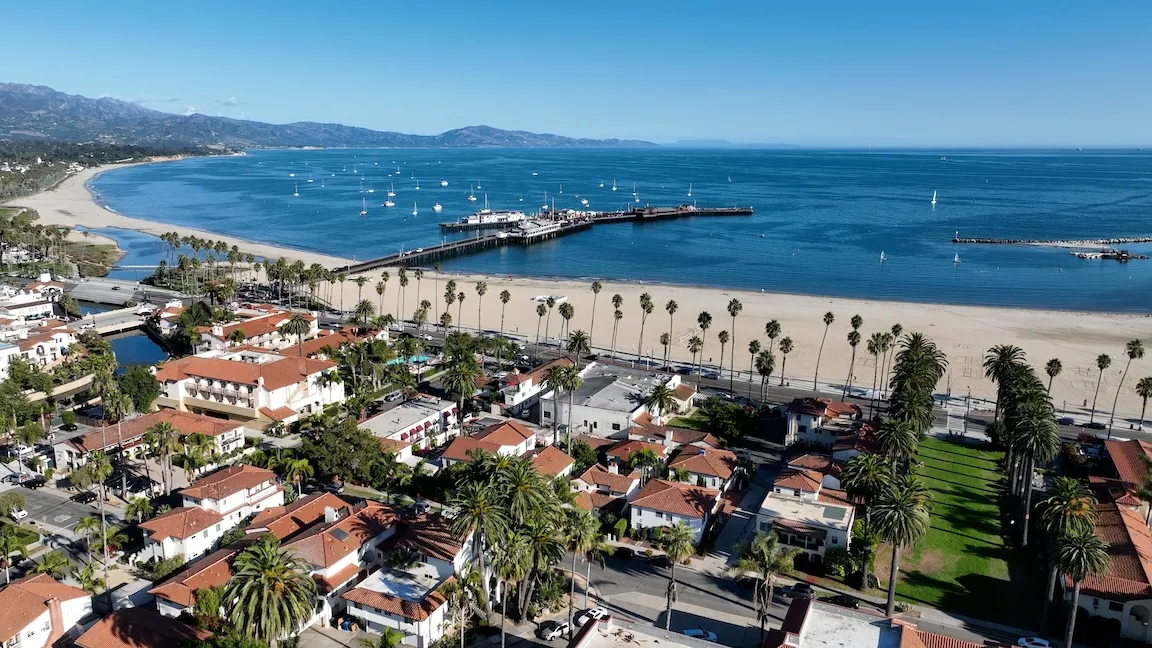
Cycling Santa Barbara Wine Country: The American Riviera by Bike
Some places earn their nicknames. Santa Barbara has spent nearly a century living up to "the American Riviera" — red-tile roofs, whitewashed walls, and palm-lined streets set against the Pacific, with a climate and elegance that genuinely does evoke the Mediterranean. But the real reward for cyclists lies just inland, where the coast gives way to rolling vineyards, olive groves, and horse ranches in one of California's most distinctive wine regions — a landscape shaped by a rare piece of geography that most visitors never think to ask about.
A tour through this stretch of California's Central Coast typically links the city of Santa Barbara with Solvang, in the heart of the Santa Ynez Valley, and Ojai on longer itineraries. The riding ranges from gentle coastal paths and vineyard-lined backroads well suited to intermediate riders and eBike users, to the genuinely demanding climbs of the Santa Ynez Mountains for anyone chasing a bigger challenge.
A Coastal City, a Danish Town, and a Mountain Retreat
Santa Barbara itself blends elegant downtown architecture with the Funk Zone, a revitalized former industrial neighborhood now packed with tasting rooms, breweries, galleries, and cafés. The Santa Barbara Mission, founded in 1786 and known as the "Queen of the Missions," remains one of California's most iconic Spanish missions, offering sweeping views over the city and gardens along with a direct window into the state's colonial history.
Solvang, a Danish-founded town in the heart of the Santa Ynez Valley, is instantly recognizable for its distinctive architecture, bakeries, and deep connection to the surrounding wine country — a lively base for tastings, dining, and exploring the valley beyond. Nearby Los Olivos offers a more compact version of the same experience: a charming wine town with a main street lined with tasting rooms, cafés, and boutiques, ideal for a relaxed lunch stop between rides.
Ojai, included on longer tours, sits framed by the Topatopa Mountains and carries a noticeably different character — artistic, boutique-oriented, and genuinely tranquil, famous above all for its "Pink Moment," a brief sunset phenomenon that bathes the surrounding mountains in shades of pink, lavender, and rose.
For strong climbers, Gibraltar Road, threading up into the Santa Ynez Mountains, delivers serious elevation gain and some of the most memorable views in the region — panoramas stretching over Santa Barbara, the Channel Islands, and the inland valleys beyond.
Three Microclimates, One Compact Region
California's Central Coast enjoys a Mediterranean-style climate overall — mild, wet winters and warm, dry summers — but conditions shift noticeably across the relatively small area covered by these routes. Santa Barbara, right on the coast, stays temperate and sunny with comfortable temperatures nearly year-round. Ojai, tucked into a sheltered inland valley, runs warmer and drier, with summer temperatures noticeably higher than the coast, though winters remain mild and sunny. Solvang, out in the Santa Ynez Valley, splits the difference: warm but not extreme summers, paired with winters that can turn crisp and occasionally rainy.
Spring and fall offer the most comfortable riding conditions, with pleasant temperatures and clear skies, while summer riders typically start early to beat the midday heat, especially around Ojai. Cycling here is generally good from March through November, and it's even possible to ride from December through February with the right preparation for rain and cooler temperatures.
A History From Indigenous Land Management to the Gold Rush
California has been home to Indigenous peoples for at least 13,000 years, with rich, distinct cultures shaped by the state's remarkably varied landscapes — from coastal fisheries to inland oak forests to desert trade routes. Hundreds of Indigenous nations, including the Chumash, Ohlone, Tongva, Miwok, Yurok, Karuk, and Kumeyaay, developed sophisticated land management practices, from acorn processing to controlled burning that actively shaped local ecosystems over millennia.
European contact began in 1542, when Spanish explorer Juan Rodríguez Cabrillo became the first known European to explore the California coast, claiming it for Spain. Sebastián Vizcaíno mapped much of the coastline in 1602 and assigned several place names that endure today, including Santa Barbara itself. Real Spanish settlement didn't arrive until 1769, when the Portolá Expedition established Spain's first foothold in Alta California, founding presidios and Franciscan missions under Father Junípero Serra — a mission system that dramatically and often violently disrupted Indigenous life through disease, forced labor, and cultural suppression.
Mexican independence from Spain in 1821 brought secularization of the missions and the redistribution of Indigenous lands into ranchos, fueling a growing cattle economy. Rising tensions between Mexico and the United States led American settlers to briefly declare the Bear Flag Republic in 1846, and the 1848 Treaty of Guadalupe Hidalgo formally ceded California to the U.S. following the Mexican-American War — the same year gold was discovered at Sutter's Mill in Northern California, igniting the Gold Rush. Hundreds of thousands of migrants poured into the state between 1849 and 1850, transforming its economy virtually overnight and accelerating displacement and violence against Indigenous communities; California achieved statehood in 1850, becoming the 31st state in the union.
The following decades brought rapid railroad expansion linking California to national markets, alongside immigrant labor — including Chinese, Japanese, and later Filipino workers — that became foundational to the state's industry and agriculture. The devastating 1906 earthquake and fires that leveled much of San Francisco prompted major rebuilding efforts and the adoption of far stricter seismic safety standards. New Deal projects and Dust Bowl migration transformed the Central Valley into one of the world's most productive agricultural regions during the 1930s, while World War II defense industries fueled dramatic population growth in Los Angeles, San Diego, and the Bay Area, laying groundwork for the postwar suburbs, highways, and aerospace innovation that followed. From Hollywood to 1960s counterculture to the rise of Silicon Valley, California spent the latter half of the 20th century becoming one of the most culturally influential places on Earth — a status it holds today, even as it continues grappling with wildfire, drought, and housing challenges.
Eating Along the Central Coast
California doesn't have a single defining national dish, but few American food cultures carry as much influence — built on unmatched access to fresh ingredients, an extraordinarily long growing season, and culinary traditions layered from Indigenous, Mexican, Asian, and European sources. Rather than heavy or formal meals, California cuisine emphasizes freshness, balance, and flexibility, often simply letting high-quality produce, seafood, and olive oil speak for themselves, with menus shifting constantly based on what's locally in season.
Mexican cuisine is foundational to food culture here, particularly in Southern California — fish tacos, carne asada, burritos, tamales, and street corn are genuine everyday fare, deeply rooted in the state's history as part of Mexico, with Baja-style seafood, fresh salsas, and handmade tortillas showing up from roadside taquerias to modern reinterpretations across the state.
California's long Pacific coastline shapes much of its cuisine as well: Dungeness crab, prawns, halibut, rockfish, anchovies, sardines, and Pacific salmon are all regional specialties, with coastal towns known for clam chowder, grilled fish, seafood tacos, and raw oysters, increasingly sourced with a focus on sustainability. San Francisco-style sourdough bread — one of California's oldest food traditions, developed during the Gold Rush and known for its chewy texture and distinctive tang from local wild yeast cultures — remains a fixture from classic bakeries to modern cafés statewide.
Olive oil has become an increasingly important part of California's food identity, particularly along the Central Coast, with groves producing everything from peppery, robust oils to lighter, buttery styles, often accompanied on local menus by citrus, figs, and stone fruit. And coffee culture runs deep here too — California has played a genuine role in shaping modern specialty coffee, emphasizing direct sourcing and careful roasting, with a coffee stop and fresh pastry a near-essential part of any local bike ride.
The Wine: A Rare Geography
Santa Barbara County stands out among California wine regions for one specific, unusual reason: its valleys run east to west rather than the more typical north-south orientation found elsewhere in the state. This rare geographic feature allows cool ocean air and fog to travel far inland, creating dramatic temperature shifts within a relatively compact area — ideal conditions for cool-climate grape varieties, and one of the primary reasons the region has become so highly regarded for Pinot Noir, Chardonnay, and Syrah, alongside Grenache, Cabernet Sauvignon, and other Rhône varieties.
Santa Barbara itself functions as the coastal gateway to the region's wine scene. While few vineyards actually lie within city limits, the Funk Zone near the waterfront concentrates a striking number of urban tasting rooms, pouring wines sourced from nearby appellations like Santa Rita Hills, Santa Maria Valley, and Santa Ynez Valley — dominated by Pinot Noir and Chardonnay under strong marine influence, alongside Syrah and select Rhône-style blends.
Solvang and the surrounding Santa Ynez Valley form one of the most vineyard-dense stretches of the country, including well-known sub-appellations like Ballard Canyon and the Los Olivos District. This part of the region leans toward Syrah, Grenache, and other Rhône varieties, alongside Pinot Noir and Sauvignon Blanc, with warm days balanced by cool evenings producing structured, expressive wines. Ojai, at the eastern edge of the wine region, offers a quieter, more intimate experience, with fewer and smaller vineyards focused on hands-on production of Syrah, Grenache, Mourvèdre, and other Rhône-inspired styles shaped by a warmer, more inland climate.
A Few Local Curiosities
Santa Barbara's distinctive Mediterranean architecture — white stucco, red tile roofs, arcaded walkways — wasn't always the norm. The look was largely shaped after a devastating 1925 earthquake, when city leaders made a deliberate decision to rebuild in a cohesive Spanish Colonial style, creating the cohesive appearance that still defines the city and sets it apart from most American towns.
Solvang's Danish character isn't a theme-park affectation — it was founded in 1911 by Danish immigrants seeking a temperate climate and agricultural land reminiscent of home, and the town continues to embrace that heritage through half-timbered buildings, windmills, bakeries, and annual Danish celebrations, remaining a genuine reflection of California's layered immigrant history.
And long before Los Angeles became synonymous with film production, Santa Barbara was an early hub for the movie industry in the early 1900s. Hollywood eventually took over, but Santa Barbara retained a quieter relationship with the arts, today hosting its own film festival, galleries, and creative communities without the spotlight intensity of its southern neighbor.
Getting There
Tours typically start in the coastal city of Santa Barbara, about 90 miles northwest of Los Angeles. Santa Barbara Airport (SBA) offers direct flights to a handful of major hubs including San Francisco, Denver, Phoenix, Dallas, and Seattle, and sits about 10 miles (15 minutes) from downtown, with taxi and rideshare fares typically running $35 to $45. Travelers flying into Los Angeles International Airport (LAX) can expect a 2 to 2.5 hour drive or 3 to 3.5 hour train journey north to Santa Barbara, with scheduled Santa Barbara Airbus transfers available for around $70 per person.
Why This Region Rewards a Bicycle
What makes Santa Barbara Wine Country such a compelling place to ride is the sheer range packed into a genuinely compact area — a Mediterranean coastal city, a Danish farming town, an artist's mountain retreat, and one of California's most distinctive wine regions, all within a single day's riding radius of each other. A car covers the ground between them easily enough. A bicycle lets you actually feel the shift as the coastal fog burns off into inland warmth, as vineyard rows replace palm trees, and as the pace of the American Riviera slows down even further, one tasting room at a time.
See the complete guidebook here

Ready to plan your tour?
Tell us where you want to go and how you want to ride. We'll send you an itinerary.