

Request a Sample Itinerary
We will send you a sample itinerary which you can further customize as you wish. We will never sell or share your email address with anyone else.
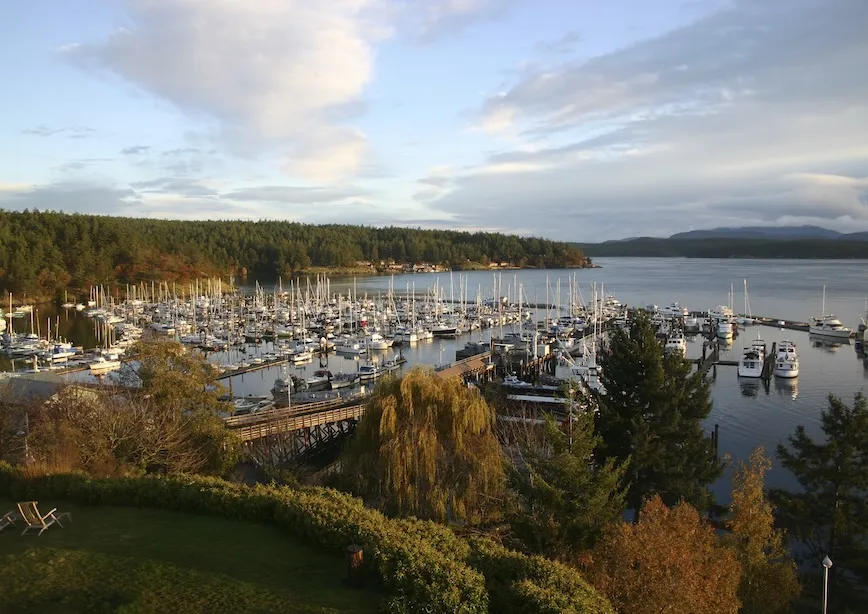
Cycling the San Juan Islands: Orcas, Ferries, and the War Fought Over a Pig
Some places wear their history lightly. The San Juan Islands wear theirs like a good story told at a dinner party — a border dispute that nearly became a war, resolved without a single shot fired over a dead pig. Add in resident orca pods, more than 400 islands scattered across the water, and a pace of life where drivers still lift a hand off the wheel to wave as they pass, and you have one of the most quietly remarkable cycling destinations in the Pacific Northwest.
A tour through the archipelago typically links Friday Harbor on San Juan Island, Eastsound on Orcas Island, and Lopez Island, with longer itineraries adding a stop on tiny, largely undeveloped Shaw Island. The ferries connecting them aren't just transportation — they're part of the experience, offering views of interisland channels and, with some regularity, sightings of seals, porpoises, sea lions, and orcas breaching just off the bow.
Four Islands, Four Distinct Personalities
San Juan Island, the most populous of the group, carries the archipelago's deepest layer of history. American Camp and English Camp, preserved within San Juan Island National Historical Park, mark the two ends of a 19th-century standoff between British and American forces. Friday Harbor itself is a lively, walkable waterfront town filled with art galleries, bookstores, and cafés, while Lime Kiln Point State Park ranks among the best land-based whale-watching spots on Earth. Roche Harbor, once a thriving lime-processing operation, has since transformed into a picturesque marina anchored by a historic hotel.
Orcas Island, the largest of the San Juans, earns its nickname "the Emerald Isle" from its lush, forested hills. Its centerpiece is Moran State Park, more than 5,000 acres of hiking trails and pristine lakes crowned by Mount Constitution — at 2,409 feet, the highest point in the islands, with a summit offering 360-degree views stretching all the way to the mainland US and Canada. Eastsound, the island's main village, has developed a genuinely thriving arts scene, with galleries, live music, and excellent dining.
Lopez Island, nicknamed "The Friendly Isle" or simply "Slow-Pez," is the most laid-back of the group, with gentle terrain, farm-to-table dining, and a welcoming community that takes the concept of a friendly wave seriously — as the guidebook wisdom goes, if a driver doesn't lift a finger off the wheel as they pass, they're probably a tourist; if they take their whole hand off to wave, they're probably a tourist trying a little too hard. Spencer Spit State Park offers a serene, sandy spit perfect for beachcombing and picnics.
Shaw Island, the smallest and least developed island served by ferry, offers peaceful roads, hidden coves, and a genuine sense of timelessness — home to the Shaw General Store, founded in 1898, and a working Benedictine monastery, Our Lady of the Rock.
A Mild Climate in the Rain Shadow
For their latitude, the San Juan Islands enjoy a surprisingly mild and dry climate — mild thanks to the moderating influence of the ocean, and notably dry because the islands sit squarely in the rain shadow of the Olympic Mountains. While nearby Seattle averages around 37 inches of rain per year, parts of the islands receive as little as 20 — a difference substantial enough to produce golden grasslands, madrona trees, and genuinely blue-sky summers that catch first-time visitors expecting typical Pacific Northwest drizzle off guard.
The best months to visit run from May through September, when temperatures stay pleasantly warm without ever turning stifling, aided by a near-constant sea breeze. Spring and fall remain viable, with the caveat that rain and cooler temperatures become more likely. Winter cycling here isn't recommended.
An Ancient Fishery and a Very Modern Border Dispute
Coast Salish peoples, particularly the Lummi Nation, have inhabited these islands for thousands of years, migrating seasonally between the islands and the mainland and developing a remarkably sophisticated relationship with the surrounding waters. Central to that relationship is reef net fishing, an ingenious technique — still practiced and demonstrated today at the Shaw Island Historical Museum — in which a net is stretched between two anchored canoes over an artificial "reef," using underwater structure and natural currents to guide fish in for a gentle, highly selective, and sustainable catch.
European contact arrived in stages. Spanish explorer Francisco de Eliza named the archipelago in 1791, honoring his patron, the Viceroy of Mexico (Orcas Island's name is actually a shortened form of that viceroy's surname, Horcasitas). British naval officer George Vancouver explored the region the following year, retaining many of Eliza's Spanish names while adding his own, and American explorer Charles Wilkes further renamed features in 1841, dubbing the group the "Navy Archipelago" — a name that didn't stick, though some of his individual place names, including Shaw, Blakely, and Sinclair, did. Throughout this period of increasing contact, smallpox and other introduced diseases devastated the Coast Salish population.
The 1846 Oregon Treaty settled the U.S.-Canada border at the 49th parallel but left the marine boundary running through the San Juan Islands genuinely ambiguous — there were, after all, two channels that could reasonably be called "the middle," Haro Strait to the west and Rosario Strait to the east. Both nations claimed the islands, and Britain's Hudson's Bay Company established a sheep ranch on San Juan Island even as American settlers began arriving in growing numbers.
The Pig War: A Standoff Resolved Without a Single Shot
On June 15, 1859, an American farmer named Lyman Cutlar found a large black pig — not for the first time — rooting through his garden, and shot it dead. The pig belonged to Charles Griffin, an Irishman running the Hudson's Bay Company's sheep operation. Cutlar offered $10 in compensation; Griffin demanded $100. When British authorities threatened to arrest Cutlar over the unpaid debt, American settlers called for military protection, and the situation escalated with startling speed. By August 1859, 461 American soldiers with 14 cannons faced off against five British warships carrying 2,140 men and 70 guns — and yet, remarkably, no shots were ever fired. Commanding officers on both sides operated under nearly identical orders: defend yourselves, but do not, under any circumstances, fire first.
President James Buchanan eventually sent General Winfield Scott to negotiate a resolution, and the two sides agreed to a joint military occupation, reduced to a token force on each side, while a permanent settlement was worked out. The dispute wasn't finally resolved until 1871, when the two nations submitted the matter to Kaiser Wilhelm I of Germany for arbitration. In 1872, the arbitration commission ruled in America's favor, establishing the boundary through Haro Strait and formally making the San Juan Islands American territory. To this day, the Union Jack still flies daily over the preserved "British Camp," raised and lowered each morning and evening by National Park Service rangers — one of the very few places without diplomatic status where U.S. government employees regularly hoist a foreign flag. Park rangers note that during the years of joint occupation, the biggest actual threat to peace on the island wasn't international tension at all, but "the large amounts of alcohol available."
Eating Like an Islander
Food and drink in the San Juans carry a distinctly Pacific Northwest character — local, seasonal, and sustainable, with a strong artisanal streak running through nearly everything. Hand-crafted cheeses, small-batch jams, wood-fired breads, and charcuterie are widely available from producers you can often meet directly at local markets, with names like San Juan Island Cheese and Horseshoe Farm leading a genuinely thriving local food scene. Coffee culture runs deep too, in true regional fashion — Holly B's Bakery on Lopez Island and Brown Bear Baking in Eastsound are both institutions, beloved by locals and visitors alike.
The farm-to-table movement has particularly strong roots on Lopez Island, where small organic farms produce heirloom vegetables, fresh greens, berries, and artisanal cheeses, sold through farmers' markets and local grocers throughout the islands. Seafood, unsurprisingly, is a genuine centerpiece — Dungeness crab, halibut, Pacific salmon, and oysters are all regional specialties, frequently caught just hours before reaching the plate, with many island restaurants running dock-to-dish menus and smoked salmon appearing as a common local delicacy.
The islands also support a modest but genuinely thriving collection of wineries, cideries, and distilleries. San Juan Vineyard offers tastings of wine made from grapes grown in the islands' distinctly cool maritime climate, while Orcas Island is home to several cider and spirits producers drawing on fruit from nearby orchards.
A Few Local Curiosities
Friday Harbor wasn't actually the islands' first major settlement — that distinction belongs to San Juan Town, later known as Old Town, which sprang up in the 1860s near American Camp during the Pig War standoff and quickly earned a reputation for lawlessness, complete with saloons, liquor stores, and brothels. A devastating fire and Friday Harbor's superior commercial infrastructure led to Old Town's decline in the 1890s; today, little remains beyond a reference to Old Town Lagoon.
Despite their nickname, orcas aren't whales at all — they're dolphins. "Killer whale" traces back to a mistranslation of the Spanish phrase asesino de ballenas, meaning "whale killer," coined by sailors who observed orcas hunting larger whale species. These days, "orca" has increasingly become the preferred term.
The San Juan archipelago actually consists of more than 400 islands, reefs, and rocks, though only about 20 are inhabited year-round, and just four — San Juan, Orcas, Lopez, and Shaw — are served by Washington State Ferries, making them the most accessible for visitors. The rest are reachable only by private boat or kayak, and many are designated wildlife refuges or nature preserves.
Getting There
Tours typically start in Friday Harbor on San Juan Island. Options include flying direct from Seattle's Boeing Field via Kenmore Air (roughly $250 round trip, with a free shuttle from SEA-TAC), driving to Anacortes for the Washington State Ferry, or taking an airport shuttle or taxi transfer from Seattle directly to Anacortes.
Whale Watching From the Shore
Lime Kiln Point State Park, on the west side of San Juan Island, is one of the only places in the world where gray whales and orcas can be reliably spotted from dry land rather than a boat. Known locally as "Whale Watch Park," it's a favorite vantage point for watching the resident Southern Resident orca population pass through Haro Strait, particularly in summer, with interpretive displays, a lighthouse dating to 1919, and knowledgeable rangers adding context to the experience. It's a fitting complement to a region where wildlife sightings — from the deck of a ferry or the shoulder of a quiet country road — are as much a part of the ride as the scenery itself.
Why the San Juans Reward a Bicycle
What makes this archipelago such a natural fit for cycling isn't just the gentle terrain, though the islands are genuinely welcoming to riders of every level. It's the accumulated texture of the place — a ferry ride that might include an orca sighting, a farm stand run by someone you'll meet again at the evening's dinner table, a stretch of road where the wave from a passing driver tells you more about the island's character than any guidebook could. A car would get you around efficiently enough. A bicycle, and the ferries between islands, move at exactly the unhurried pace this quietly extraordinary corner of Washington has always kept for itself.
See the complete guidebook here.

Ready to plan your tour?
Tell us where you want to go and how you want to ride. We'll send you an itinerary.