

Request a Sample Itinerary
We will send you a sample itinerary which you can further customize as you wish. We will never sell or share your email address with anyone else.
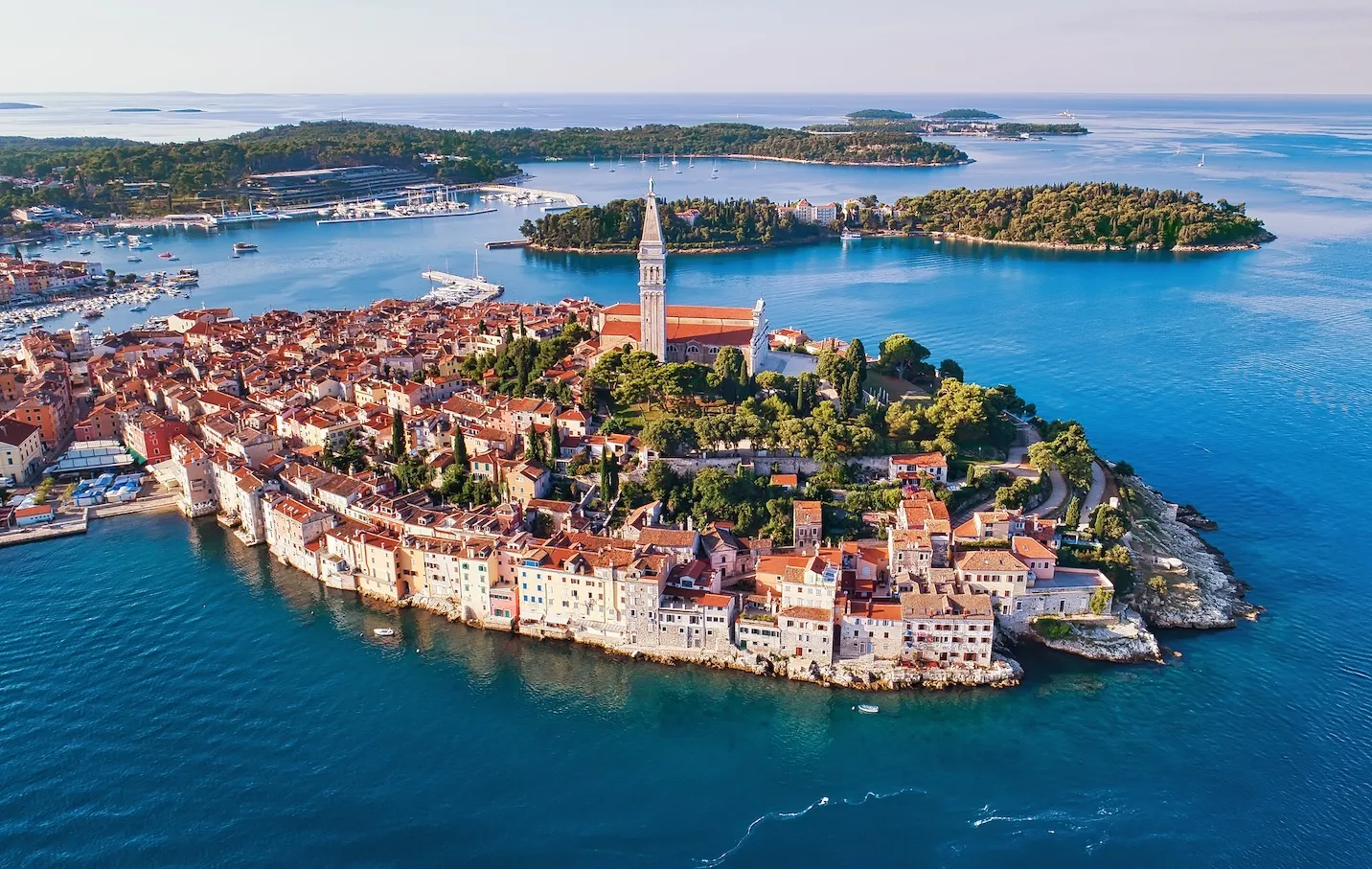
Cycling Istria: Truffles, Terracotta, and Croatia's Two-Faced Peninsula
Some peninsulas commit to one identity. Istria refuses to choose. Ride inland and you're winding through hilltop villages perched above vineyards and truffle-laden forests, the kind of landscape that looks lifted straight from Tuscany. Ride toward the coast and you land in walled Venetian port towns with pastel façades and the unmistakable salt-air hum of the Adriatic. Both versions are entirely Istrian, and a cycling tour is really the only way to experience the seam where they meet.
A tour through this heart-shaped peninsula in northwestern Croatia typically links Buje, Poreč, Rovinj, and Fažana, often starting or ending in Trieste, Italy, or Pula, Croatia. Along the way, riders pass through a region shaped by an unusually deep list of former rulers — Romans, Venetians, Austro-Hungarians, and others have each left a visible mark on Istria's architecture, cuisine, and culture.
A Peninsula of Two Landscapes
Istria's interior is dotted with hilltop villages set among ancient farms, forests, and rolling hills, while the coast delivers craggy coves, centuries-old fishing ports, and the sparkling waters of the Adriatic, along with walled cities whose bones date to the Venetian Republic. It's this contrast that gives the peninsula its character — and its reputation, increasingly, as the gastronomic heart of Croatia, drawing food-focused travelers from around the world for a cuisine that fuses Italian and Slavic traditions into something distinctly its own.
- Buje — A fortified hilltop town overlooking vineyards and olive groves, its narrow alleys leading to quaint squares, art galleries, and charming restaurants.
- Poreč — A beautifully preserved old town on a peninsula, its cobbled streets, Roman architecture, and imposing basilica earning UNESCO World Heritage status.
- Rovinj — Originally a small island protected by stone walls, joined to the mainland when the channel between them was filled in 1763. Its Venetian history, winding cobblestone streets, and pastel-hued houses have earned it the nickname "Mini Venice."
- Motovun, Sveti Lovreč, Svetvinčenat, and Bale — A cluster of medieval walled hilltop villages scattered through the interior, each with ancient churches and belltowers that double as both route markers and welcome rest stops for cyclists exploring the peninsula's hinterland.
Along the coast, smaller fishing towns like Umag and Novigrad remain little havens of beauty on an otherwise craggy shoreline, largely unchanged over the centuries, with the smell of freshly cooked seafood a near-constant companion. And offshore, Brijuni National Park carries an unexpected 20th-century footnote: the islands once served as Yugoslav leader Josip Tito's private summer retreat, frequented by world leaders and celebrities, and today open to visitors as a blend of historical sites and natural beauty.
The tour's start and end points, Trieste and Pula, are worth exploring in their own right — Trieste offering a fascinating blend of Italian and Austro-Hungarian character, and Pula home to one of the best-preserved Roman amphitheaters anywhere in the world.
A Climate Built for Shoulder-Season Riding
The best months to visit the Istrian Peninsula run from April through October, though July and August can run genuinely hot for some tastes, with temperatures often climbing past 90°F and occasionally past 100°F. Spring, early summer, and early fall are particularly good windows, letting riders sidestep both the summer heat and the summer crowds. Winter and late fall bring more rain along with the occasional Bura (or Bora) wind — a strong, cold northeasterly gust that can make cycling conditions genuinely unpredictable during the colder months.
A History Layered by Empires
Croatia's broader history reads like a survey of every major European power that ever had Adriatic ambitions — Roman, Byzantine, Venetian, Ottoman, Austro-Hungarian, and Yugoslavian influence all left their mark before the country achieved independence in 1991, joined the European Union in 2013, and adopted the euro in 2023. Istria's own story stretches back to the Illyrians, an ancient Indo-European people, before Rome moved against Queen Teuta of Illyria in 229 BCE following Greek complaints about Illyrian piracy. Roman rule followed for centuries, and by the 7th century, Croats had settled the region, laying foundations for what would become the Croatian nation.
The medieval period brought its own drama: King Charlemagne's Franks conquered Dalmatia around 800 CE, enforcing Christian baptism on the Croats, and in 925 Tomislav became the first recognized king of Croatia. A 1102 agreement called the Pacta Conventa united the Kingdom of Croatia with the Kingdom of Hungary for centuries to come, though several Istrian cities that rose up against Venetian control in 1145 were defeated and absorbed into close Venetian oversight — a relationship that would define much of Istria's coastal character for centuries. Venetian influence expanded further in 1409, when Ladislas of Naples, facing dynastic conflict, sold Dalmatia to Venice outright for 100,000 ducats.
The Habsburgs assumed control of Croatia in 1527, beginning a long period of Austrian influence punctuated by ongoing conflict with Ottoman forces, who were finally pushed out of Croatian territory by 1699. Napoleon dissolved the Venetian Republic between 1797 and 1815, briefly folding the Adriatic coast into his "Illyrian provinces," and the 19th century saw the rise of South Slavic national consciousness pushing back against Habsburg Germanization policies. The Austro-Hungarian Dual Monarchy, formed in 1867, divided Croatian territory between Austria and Hungary, and after World War I, Istria was occupied by Italy, triggering forced Italianization and the mass migration of many Croats. World War II brought Croatia's transformation into a fascist puppet state, followed by incorporation into socialist Yugoslavia under Marshal Tito in 1945 — with Istria formally becoming part of Croatia in 1947, prompting many ethnic Italians to leave for Italy. Croatia's 1991 declaration of independence from Yugoslavia led to the Croatian War of Independence, concluded by the 1995 Dayton Agreement, setting the stage for the country's eventual EU accession in 2013.
Eating the Gastronomic Heart of Croatia
Istrian cuisine blends Mediterranean and Central European flavors into something built on simplicity and authenticity — olive oil, truffles, and fresh seafood form the backbone of the local table. Lunch, considered the primary meal by many Croatians, typically opens with soup, often the traditional maneštra — a hearty, satisfying blend that might include potatoes, corn, beans, chickpeas, fennel, cabbage, and sometimes špek (bacon).
Istrian ham (pršut) has been produced in the region since the 16th century and today carries protected European origin status, made from carefully selected pork legs through a meticulous salting and air-drying process influenced by historical Venetian curing methods. The annual "Pršut Days" festival celebrates the craft each year.
But it's truffles that have really put Istria on the international culinary map, particularly the deciduous woodlands between Buzet, Motovun, and Oprtalj. Istrian white truffles (Tuber magnatum) fetch around €800 per kilo for smaller specimens and well over €2,000 per kilo for larger ones, while black "summer" truffles run closer to €600 per kilo — genuinely more affordable than their Italian and French counterparts, to the point that Italians are known to cross the border specifically to buy Istrian truffles instead. The white truffle season runs September through January; black truffles can be harvested year-round. In November 1999, Giancarlo Zigante and his dog Diana unearthed a record-breaking 1.31 kg white truffle near Buje, landing a spot in the Guinness Book of Records — rather than sell it, Zigante used the "millennium truffle" to host an elaborate banquet for 100 guests, and has since built a genuine truffle empire with shops across the region and a celebrated restaurant in Livade.
Beyond truffles, expect grilled Adriatic seafood like branzino, scampi, and cuttlefish; hearty meat dishes featuring pršut, sausages like kobasice, and grilled lamb or veal, often served alongside truffle-infused sides; and the prized native Boškarin ox, considered a genuine delicacy. Traditional pasta, fuži, pairs particularly well with game like venison or wild boar. For dessert, look for fritule (small doughnut-like pastry balls), kroštule (fried sweet pastry ribbons dusted with sugar), and pinca, a traditional sweet Easter roll.
Istrian olive oil culture runs remarkably deep — there's an olive tree on Veli Brijun in the Brijuni Islands proven to be 1,600 years old — and local growers harvest earlier than most regions to preserve natural antioxidants, producing oils with a slightly more bitter, and arguably healthier, character.
The Wines: Malvazija and Teran
Croatian wine may be a relatively recent discovery for international drinkers, but it's been enjoyed locally for more than 25 centuries, with Istrian wine production dating back to Roman times. Two indigenous grape varieties define the region: Malvazija Istarska, the flagship white, celebrated for crisp acidity and floral notes with hints of citrus and Mediterranean herbs, and Teran, Istria's best-known red, grown in iron-rich terra rossa soil and known for deep color, robust character, and a distinctive minerality. Beyond these two, the region also produces Muscat, Chardonnay, Pinot Gris, and Sauvignon Blanc whites, alongside Merlot, Cabernet Sauvignon, and Refošk reds. Vineyards here are predominantly small, family-run operations, concentrated especially in the north and northwest of the peninsula, where terra rossa soil, humus, undulating hills, and coastal breezes combine to create genuinely diverse microclimates.
A Few Local Curiosities
The Parenzana, a narrow-gauge railway that once connected Trieste and Poreč across 123 kilometers of track, operated from 1902 to 1935 before being abandoned and eventually repurposed into a scenic cycling and hiking trail through the heart of Istria (better suited to mountain bikes given some rough surfaces). Its inaugural run was so plagued by delays that many believed the whole thing was an April Fool's joke, and only a sparse crowd turned out for the ceremonial first arrival on April 1, 1902.
Rovinj's patron saint, St. Euphemia, has a suitably dramatic origin legend: martyred in Constantinople in 304 CE, her sarcophagus is said to have miraculously drifted to Rovinj's coast centuries later, resisting all attempts to move it uphill until a small boy with two cows succeeded where grown men had failed. The town still celebrates her feast day every September 16th with mutton and sauerkraut, followed by fritule.
Rovinj's deep maritime identity also lives on through the batana, a small traditional wooden fishing boat still built by hand in the town center during summer, and bitinada songs — an a cappella singing tradition said to have originated with fishermen whose hands were too occupied with nets and oars to play instruments, so they turned their voices into an orchestra instead.
Getting There
Tours typically start in Pula or Trieste, with optional pickup from Venice. Pula's small airport connects to several European cities including Amsterdam, Frankfurt, London, and Paris, though there are no direct flights from North America. Trieste offers a wider regional network, while Venice's larger airport provides the most convenient option for travelers flying directly from the U.S. or Canada.
Why Istria Rewards a Bicycle
What makes this peninsula such a compelling place to ride is precisely the contrast it refuses to resolve — a truffle hunt in a hilltop forest one morning, a plate of grilled seafood on a Venetian-walled harbor the next evening, both entirely genuine, both entirely Istrian. A car covers the distance between the coast and the interior easily enough. A bicycle lets the transition actually register, mile by mile, as vineyard terraces give way to pastel façades and the scent of truffle oil gives way to salt air.
The complete guidebook can be downloaded here
Ready to plan your tour?
Tell us where you want to go and how you want to ride. We'll send you an itinerary.