

Request a Sample Itinerary
We will send you a sample itinerary which you can further customize as you wish. We will never sell or share your email address with anyone else.
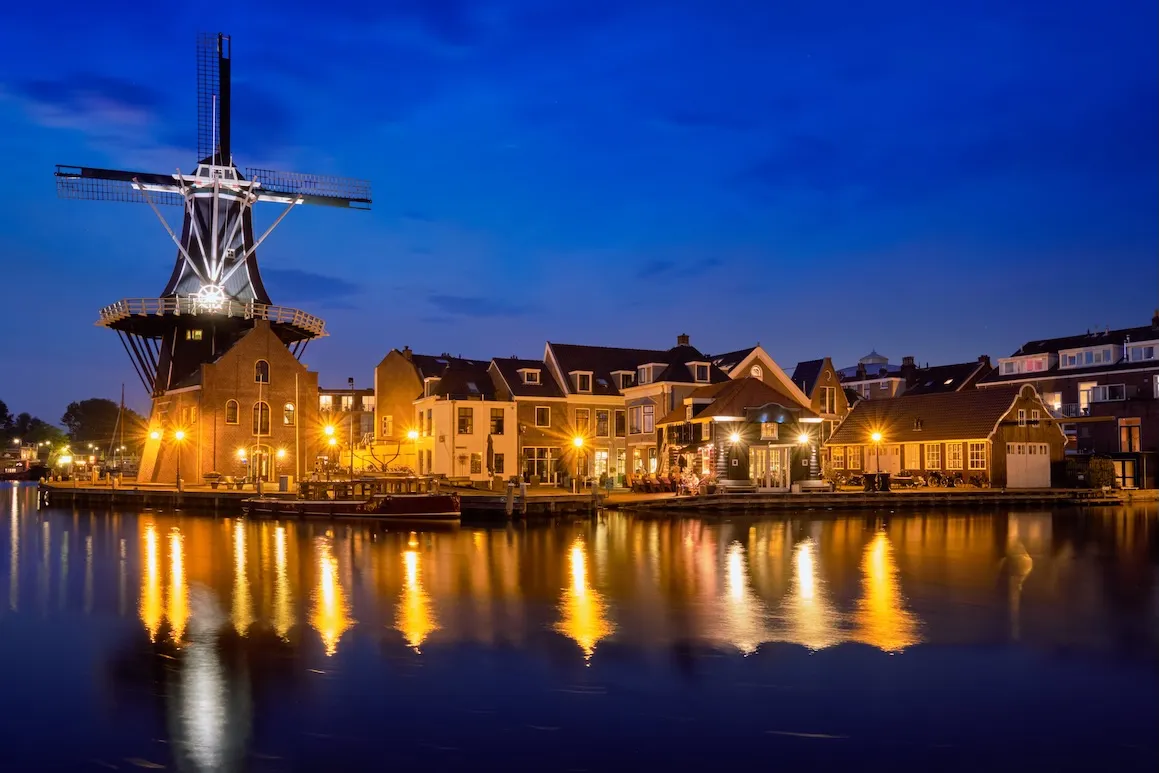
Cycling Holland: Windmills, Tulips, and a Country Built for Two Wheels
Some countries tolerate cyclists. The Netherlands was practically built around them. With more than 20,000 miles of traffic-free bike paths, trains that welcome bikes on board, and roads where cyclists hold the right-of-way as a matter of course, this is, without much argument, the most bicycle-friendly country on the planet. Add in tulip fields, working windmills, and a string of medieval cities with world-class museums tucked between their canals, and you have a cycling destination that somehow lives up to its own hype.
A tour through this stretch of the Netherlands typically links Utrecht, Gouda, Leiden, Haarlem, and Alkmaar, often starting and ending in Amsterdam. Along the way, riders pass through dense forests, tranquil waterways, and acres of flowering fields, threading between cities that feel less like tourist stops and more like living museums with excellent coffee.
What's in a Name?
Before getting to the routes, a small clarification the Dutch themselves are used to making: "The Netherlands" and "Holland" are often used interchangeably, even within the country itself, but they're not technically the same thing. North Holland and South Holland are just two of the Netherlands' twelve provinces — the country's formal name is Koninkrijk der Nederlanden, literally "Kingdom of the Low Countries," which also includes the Caribbean islands of Aruba, Curaçao, and Sint Maarten. The name "Holland" is used here for ease and name recognition, and these tours run almost entirely through North and South Holland, with the exception of Utrecht, which sits in its own separate province.
And while we're clearing things up: the English word "Dutch" comes from Deutsch, the German word for German. The English originally didn't draw much distinction between the Germanic peoples of the region; after the Netherlands became an independent state, "Dutch" narrowed to mean people from the Netherlands specifically, while the rest eventually became known as Germans.
Five Cities, Five Distinct Characters
Utrecht, one of the Netherlands' oldest cities, is a lively university town anchored by the Oude Gracht — perhaps the most scenic canal in the entire country. Gouda is known, unsurprisingly, for its namesake cheese and the medieval cheese market held in its Markt square, overlooked by a 15th-century town hall with iconic red-and-white shutters. Leiden, laced with canals lined by 17th-century buildings, is the birthplace of Rembrandt and home to the country's most prestigious university.
Haarlem offers grand churches, cobblestone streets, intimate bars, and fine cafés, along with impressive museums including the Frans Hals Museum. Alkmaar, known as the city of cheese, brings a beautiful old center, excellent shopping, countless terraced cafés, and — naturally — a cheese museum of its own. And Delft, best known for its distinctive blue-and-white pottery, offers an old town that looks like it stepped directly out of a Vermeer painting — fitting, since the grand master was born and lived there.
Beyond the cities, a few highlights define the riding itself. The stretch between Leiden and Haarlem passes through the country's most concentrated tulip fields, and in season, the Keukenhof Botanical Gardens are an essential stop for flower lovers. The North Sea Coast offers long stretches of unspoiled beach framed by dunes, with bike paths crossing the dunes themselves and passing through seaside resorts like the bustling Zandvoort. And windmills — more than 1,200 surviving originals remain across the country, with some of the most historic clustered at Zaanse Schans, offering a genuinely emblematic image of the Netherlands still doing real work in the landscape.
A Climate That Rewards a Spring Visit
Holland's climate is a Marine West Coast type, similar to England and northern France — proximity to the North Sea and Atlantic keeps summers relatively cool and winters mild. Being small and flat, the country maintains a fairly uniform climate throughout, though the coast runs a bit cooler and windier than inland areas.
The best time to visit runs from mid-May to mid-September, when temperatures are typically mild to pleasantly warm. From mid-April to mid-May, the country transforms into a genuine spectacle, with tulip and flower fields in full bloom. June, July, and August are the warmest months. Whatever time of year you travel, pack waterproofs and some warm layers — most weeks bring a mix of sunshine and rain regardless of season.
A History of Greed, Lust, War, Pirates, and High-Seas Adventure
The Netherlands' own guidebook sums up its history bluntly: "It is complicated. Greed, lust, war, pirates, and high-seas adventures. But it all works out in the end with a society based on a belief in human rights, consensus, and tolerance." The story starts remarkably early — people living in what's now Drenthe province were moving enormous rocks to build structures before Stonehenge existed, somewhere around 3000–2000 BCE. The Romans arrived in 59 BCE, building towns and roads still visible today, and Christianity spread through the region by 800 CE.
Between 1150 and 1300, the Dutch began their long-running tug-of-war against the sea, building the first dams in what would become centuries of land reclamation. Amsterdam was founded in 1275, gaining direct access to the sea via the Zuiderzee — though that same body of water flooded catastrophically in 1287, killing more than 80,000 people. City-states flourished through the 1200s and 1300s, with riverside lords accumulating massive wealth through trade, until dukes began consolidating power in 1419, curtailing that earlier freedom.
The 16th century brought Habsburg control under Charles, who became King of Spain and Holy Roman Emperor, effectively ruling the Netherlands from abroad and imposing Catholicism as the official religion. Philip II's crackdown on Protestants sparked religious war, and between 1568 and 1648 the Low Countries fought the Eighty Years' War for religious freedom, eventually winning independence from Spain. What followed was the Dutch Golden Age: the Dutch East India Company formed in 1596, Amsterdam's grand canal ring was constructed through the 1600s as the city's population surged past 200,000, and in 1602 Amsterdam became home to the world's first stock exchange. In 1620, the Pilgrims set sail for the New World aboard the Mayflower — a voyage that actually began in Leiden. A notorious speculative bubble, Tulipmania, gripped the country in 1636–1637, and in 1667, following various disputes with England, the Dutch swapped New Amsterdam for Surinam — and New Amsterdam became New York.
French troops arrived in 1795, and after their eventual overthrow, Willem VI of Orange was crowned Dutch King Willem I in 1813–1814, uniting the Protestant north and Catholic south as the United Kingdom of the Netherlands — a union that didn't last, as the southern provinces seceded with French help in 1830 to form Belgium. The Netherlands stayed neutral during World War I while trading with both sides, and KLM took to the skies in 1919, making it today's oldest still-operating airline. Centuries of dyke-building and flooding culminated in the ambitious Zuiderzee reclamation project beginning in 1932, spurred by a deadly 1916 storm surge.
World War II brought genuine tragedy: Germany invaded in 1940, destroying Rotterdam by air raid and sending the Dutch government into exile in London under Queen Wilhelmina, while the Nazis used the Westerbork camp — originally established by the Dutch government to house Jewish refugees — as a transit point for 107,000 Jews sent to death camps. The Allies liberated the southern Netherlands in 1944–45, but the cut-off north and west endured the deadly "Winter of Hunger" before full liberation arrived.
Post-war, the Netherlands rebuilt and modernized rapidly: the International Court of Justice set up in Den Haag in 1946, and the catastrophic 1953 Zeeland floods spurred the multi-decade Delta Project beginning in 1958. In 2001, the Netherlands became the first country in the world to legalize same-sex marriage. Queen Beatrix abdicated in 2013 after a 33-year reign, handing the throne to her son Willem-Alexander — the first Dutch king in 123 years. And in 2023, Dutch politics saw one of its biggest upsets since World War II, when the right-wing Party for Freedom, led by Geert Wilders, won 37 of 150 parliamentary seats.
Eating and Drinking the Dutch Way
Traditional Dutch food is hearty and comforting, shaped by the country's maritime heritage and agricultural bounty. Stroopwafels — thin waffle cookies filled with sweet caramel-like syrup, best enjoyed warm atop a hot cup of coffee — are perhaps the most internationally recognized Dutch treat, offering a satisfying combination of chewy and crisp. Bitterballen, popular pub snacks featuring deep-fried, crispy meat-filled balls served with mustard, are a fixture of Dutch bar culture. Herring, often eaten raw with onions and pickles, reflects the country's deep maritime traditions, while erwtensoep, a thick pea soup, makes for ideal cold-weather fuel. Poffertjes, mini fluffy pancakes topped with powdered sugar and butter, round out the country's sweeter indulgences.
Cheese, naturally, plays a starring role, with Gouda and Edam renowned worldwide. Gouda specifically is made from cow's milk through a traditional process of curdling, pressing, and aging, ranging from young and creamy to aged and crumbly with pronounced caramel notes — versatile enough to enjoy on its own, melted into dishes, or paired with fruit and wine.
A Few Local Curiosities
Tulipmania, the Dutch tulip craze of 1636–1637, ranks among history's most famous economic bubbles — arguably the first on record. Before 1633, tulip trading had been restricted to professional growers, but rapidly rising prices lured ordinary families into speculation, with homes and estates mortgaged to buy bulbs purely for resale, sometimes changing hands multiple times without ever leaving the ground. The market collapsed in early 1637 when doubts crept in about continued price increases, wiping out fortunes overnight.
The Netherlands is also home to some remarkable defensive engineering: Naarden-Vesting, a star-shaped 12-pointed fortress in the town of Naarden, remains one of the best-preserved military structures in the country — though it was completed only after Spanish forces had already massacred the town's inhabitants in the 16th century, a somewhat bitter irony given its purpose. The bastions remained staffed by the Dutch army until the 1920s, long after any real tactical relevance had passed.
The Dutch national anthem, the Wilhelmus, holds the distinction of being the oldest national anthem in the world, with both words and music dating to the 16th century. And Dutch people themselves are a genuine outlier: Dutch men are, on average, the tallest in the world at 182.5 cm, with Dutch women ranking second tallest globally after Latvia. Remarkably, Dutch males have grown about 20 cm over the past 200 years, compared to roughly 6 cm for Americans over the same period — a shift researchers attribute not just to genetics but to universal healthcare, low social inequality, and a diet rich in dairy.
Geographically, the Netherlands is also the lowest country in Europe, with 26% of the country sitting below sea level and roughly 60% of the population living within five meters of it — Amsterdam's Schiphol Airport, where most visitors land, sits three meters below sea level. The windmills scattered across the countryside were historically put to work pumping that water back out.
On a darker historical note, the town of Oudewater, on the Utrecht-to-Gouda route, holds an unusual claim to honor: during the witch-hunt era, Holy Roman Emperor Charles V considered Oudewater's weighing scales the only "fair equipment" in his empire for determining witchery, based on the grim logic that a woman too light for her frame must be a witch. No woman ever weighed there was found guilty — a fact still held up locally as proof the town's officials refused to take bribes to rig the results.
Getting There
Tours typically start in Amsterdam, most easily reached via Amsterdam Airport Schiphol (AMS), the fifth-busiest airport in the world, with direct flights from most major European cities and numerous North American hubs including New York, Los Angeles, and Chicago. From the airport, taxis to central Amsterdam cost around €45 and take about 30 minutes, while a regular train service runs the same route in 15–20 minutes for roughly €6.
Why Holland Rewards a Bicycle
What makes the Netherlands such an obvious cycling destination is the sheer intentionality of it — this is a country that has spent decades building infrastructure around the assumption that people will travel by bike, not despite it. A car would get you between Utrecht and Alkmaar easily enough, missing nearly everything that makes the trip worthwhile in the process. A bicycle, on genuinely dedicated paths, moves through the tulip fields, past the windmills, and into the medieval city centers at exactly the pace this endlessly considerate country was built for.
The complete guidebook can be downloaded here.

Ready to plan your tour?
Tell us where you want to go and how you want to ride. We'll send you an itinerary.