

Request a Sample Itinerary
We will send you a sample itinerary which you can further customize as you wish. We will never sell or share your email address with anyone else.
Cycling the Big Island: A Continent's Worth of Scenery in One Volcanic Island
Most people picture Hawaii through a fairly narrow lens: swaying palms, iconic beaches, maybe a mai tai at sunset. The Big Island has all of that, but riding it by bicycle reveals something else entirely — a place where a single day's route can carry you from tropical rainforest to arid lava field to misty upland pasture, as if you'd pedaled across an entire continent rather than one island. This is Hawaii in its rawest and most varied form, and a bike is genuinely the best way to take in the contrasts.
A cycling tour through the Big Island typically links Captain Cook on the Kona coast, Volcano near Hawaii Volcanoes National Park, Hilo on the lush eastern side, and Waimea in the upcountry ranchlands. Along the way, riders pass through coffee farms, sacred historical sites, active volcanic landscapes, waterfall-fed rainforest, and windswept coastal villages — a genuinely dramatic range of terrain packed into one island roughly the size of Connecticut.
Coffee, Coastline, and Sacred Ground on the Kona Side
The Kona coast opens the tour with the scent of roasting coffee beans drifting from family-run farms, many of which welcome visitors in for tastings of their prized 100% Kona coffee — a crop that can only truly be grown in the Kona districts, between 800 and 2,000 feet of elevation, where volcanic soil, ideal rainfall, and elevation combine to produce one of the most sought-after (and expensive) coffees in the world.
Captain Cook, a quiet hillside village overlooking the coast, sits near Kealakekua Bay, a pristine marine sanctuary and one of the best snorkeling spots in Hawaii — as well as the site of Captain James Cook's death in 1779. Nearby, Puʻuhonua o Hōnaunau National Historical Park preserves a sacred site that once served as a place of refuge under ancient Hawaiian law, its thatched temples and royal fishponds offering a direct window into pre-contact Hawaiian culture. For riders wanting to escape the tourist bustle entirely, Cane Haul Road offers an unassuming back route through woodland, sugar-cane fields, and meadows, with views of cinder cones and ocean beyond.
Into an Active Volcanic Landscape
From the coast, routes climb toward Hawaii Volcanoes National Park, one of the most geologically active places on Earth and home to both Kīlauea and Mauna Loa. The park's lava tubes, steam vents, and dramatic craters offer a landscape that looks genuinely otherworldly, and when conditions align, riders may catch glimpses of glowing lava flows and steaming vents up close. Kīlauea itself has erupted dozens of times in modern history, including a major eruption in 2018 that reshaped parts of the island, and the park's significance has earned it UNESCO World Heritage status.
The Lush East Side and Waterfall Country
On the wetter eastern side of the island, Hilo serves as the county seat and administrative capital, a rain-soaked town known for lush gardens, historic charm, vibrant markets, and Japanese gardens that reflect the island's layered immigrant history. Just outside town, Rainbow Falls takes its name from the morning rainbows that often shimmer in its mist, and local legend holds that Hina, mother of the demigod Māui, once lived in a lava tube behind the 80-foot cascade.
Nearby, Akaka Falls State Park rewards a short, scenic hike with views of two waterfalls, including the spectacular 442-foot Akaka Falls — among the most impressive on the island.
Climbing to the Upcountry: Waipio, Waimea, and the Roof of Hawaii
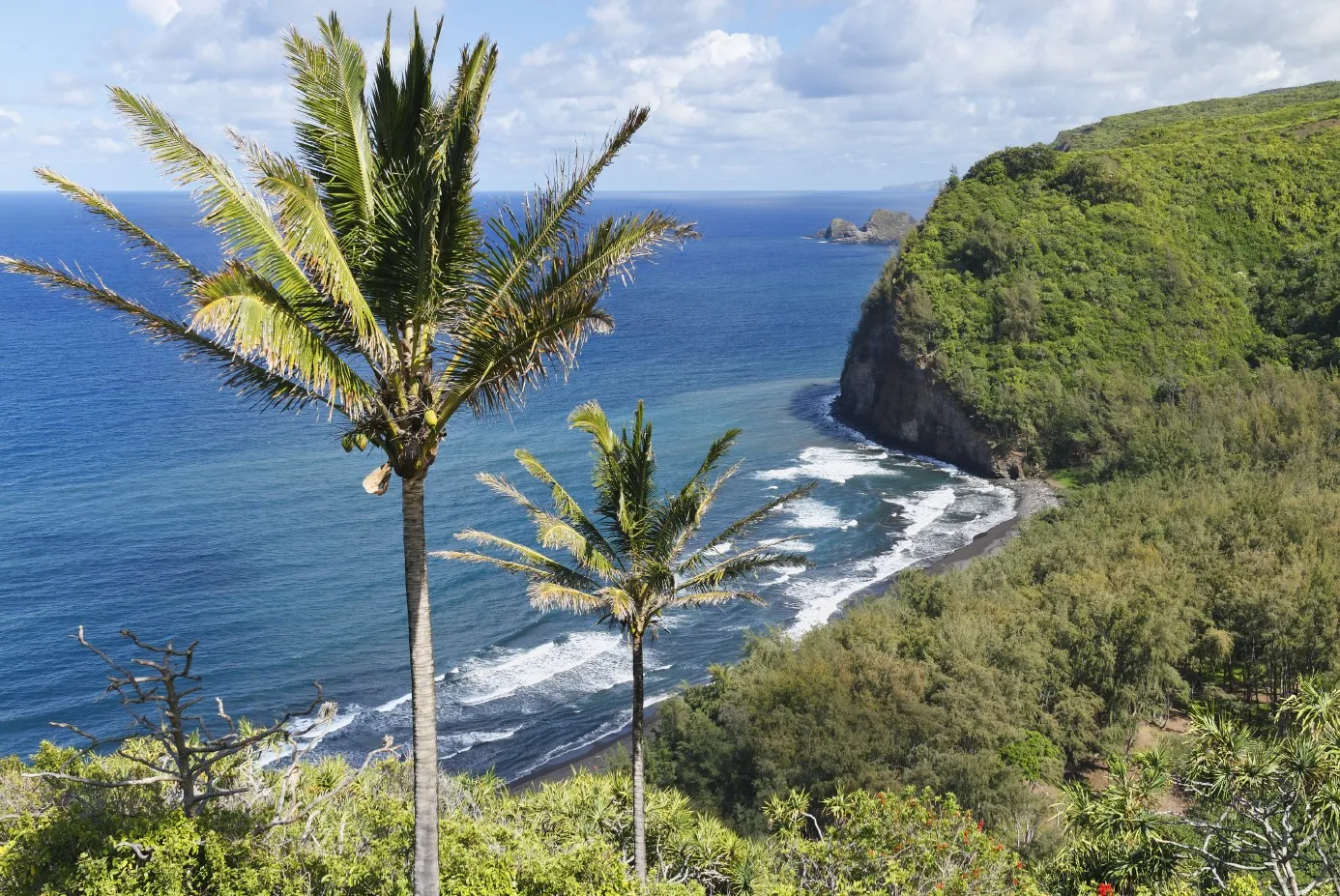
From Hilo, routes climb via the dramatic Waipio Valley, a canyon defined by towering cliffs, cascading waterfalls, and a black sand beach. Riders typically stop at the overlook rather than descending, since the road down is one of the steepest and most grueling on the island and access is restricted to locals and pre-booked tours. It's tempting to wonder whether you could ride it yourself — the honest answer, for most cyclists, is no. The road averages a 25% grade and maxes out at a genuinely absurd 40% in places, all while being potholed and prone to out-of-control rental cars. For the record, Lance Armstrong once climbed it in 9½ minutes at 430 watts. Everyone else should probably just enjoy the view from the top and bring hiking shoes if they want to explore under their own power.
Beyond Waipio lies Waimea (also called Kamuela), a pastoral upcountry town known for its rolling green hills and paniolo — Hawaiian cowboy — heritage, blending ranching culture with fine dining and serious science; the headquarters of the W. M. Keck Observatory is based here. Towering above the whole island is Mauna Kea, at 13,803 feet the highest point in Hawaii and, measured from its base on the ocean floor, technically the tallest mountain on Earth. The summit hosts 13 international observatories and is considered one of the best places in the world for astronomical observation, thanks to its elevation, dry air, and minimal light pollution — though access to the true summit is regulated, and most visitors stop at the Visitor Information Station at 9,200 feet unless joining a guided 4WD tour.
The tour typically wraps along the Kohala Coast, a string of pretty coves and sandy beaches that also happens to be the route of the Ironman World Championship and home to the island's most luxurious resorts.
A Mild Climate With a Catch: Location Matters More Than Season
The Big Island enjoys a mild climate year-round, with coastal highs typically in the high 70s to low 80s °F. Winter, running November through April, is slightly cooler than summer, but season matters far less here than location. As a general rule, the west coast runs warmer and drier, conditions get progressively wetter heading east, and temperatures drop the higher up you climb — a single day's ride can move through several distinct microclimates entirely because of elevation and coastline, not the calendar. Like any tropical island, windy days are always a possibility. There's genuinely no bad time to visit, though winter brings slightly cooler, wetter conditions.
A History Shaped by Navigation, Sovereignty, and Statehood
Hawaii has been inhabited by Polynesians for well over a thousand years, developing a rich and complex culture built around land stewardship, celestial navigation, and kapu, a system of sacred law. The first wave of Polynesian voyagers arrived from the Marquesas Islands before 1000 CE, navigating by stars, ocean swells, and bird patterns to reach the islands, where they established thriving settlements built around irrigated taro terraces (loʻi), fishponds, and a deep spiritual connection to the land. A second wave arrived from Tahiti between 1200 and 1400 CE, shaping the social and religious framework that would define Hawaiian society for centuries, including the kapu system and the rule of powerful aliʻi (chiefs) over distinct island districts.
European contact began in 1778, when British explorer Captain James Cook landed at Waimea Bay on Kauaʻi during his third Pacific voyage — the first recorded contact between Hawaiians and Europeans. Hawaiians initially welcomed Cook, possibly mistaking him for the god Lono given the timing of his arrival during the Makahiki season, but tensions rose on his return the following year, culminating in his death at Kealakekua Bay on the Big Island in 1779. Between 1791 and 1810, Kamehameha I unified the Hawaiian Islands through a combination of diplomacy and warfare, becoming the first ruler to control all the main islands under a single monarch, aided by Western advisors and weaponry.
American Christian missionaries arrived in Kailua-Kona in 1820, and within a generation, literacy had become widespread and Western ideas about governance, religion, and property ownership began reshaping Hawaiian society. Hawaii adopted its first written constitution in 1840, transitioning to a constitutional monarchy with a formal government structure. A brief 1843 British occupation during the Paulet Affair was resolved when sovereignty was restored by Admiral Thomas — an event still celebrated each July 31st as Lā Hoʻihoʻi Ea, or Restoration Day.
The Hawaiian Kingdom's independence came to an abrupt end in 1893, when Queen Liliʻuokalani was overthrown in a coup orchestrated by American and European residents with the support of U.S. Marines, replacing the monarchy with a provisional government despite widespread Native Hawaiian opposition. The islands were formally annexed by the United States in 1898 via the Newlands Resolution, becoming a U.S. territory in 1900 without Native Hawaiian consent. The 1941 Japanese attack on Pearl Harbor drew the U.S. into World War II and placed Hawaii under martial law, transforming the islands into a central hub for Pacific military operations. In 1959, following a statehood vote that notably did not offer the option of restoring independence — a fact still cited by sovereignty advocates today — Hawaii became the 50th U.S. state. Since the 1970s, the Hawaiian Renaissance has sparked a genuine cultural revival, with movements for Hawaiian language revitalization, land protection, and sovereignty gaining momentum alongside a restoration of traditional practices like hula, wayfinding navigation, and chant.
Eating Like a Local
Traditional Hawaiian cuisine is rooted in Polynesian heritage and shaped by centuries of migration, trade, and adaptation. Staples include taro, sweet potato, breadfruit, banana, and coconut, alongside seafood like tuna, octopus (heʻe), and saltwater fish such as moi and ʻopelu. Pork, chicken, and beef became more common with the arrival of Europeans and plantation laborers, and traditional cooking methods relied on open fires and underground ovens called imu, using hot lava rocks and banana leaves for steaming and roasting. Later waves of immigration from Japan, China, Portugal, Korea, and the Philippines layered in rice, soy sauce, noodles, and cured meats, producing the genuinely diverse food culture found across the islands today.
A handful of dishes define the local table:
- Poi — A thick, slightly sour paste made by pounding cooked taro root with water until smooth. Once a dietary staple and still culturally significant today, poi ranges in consistency from "one-finger" to "three-finger" and is traditionally served alongside kalua pork or lomi salmon.
- Kalua pig — Hawaii's signature dish, made by slow-cooking a whole pig for hours in an imu lined with hot lava rocks, banana leaves, and wet burlap until the meat turns incredibly tender and smoky. A centerpiece of lūʻau feasts and community gatherings, typically shredded and served with poi, rice, or cabbage.
- Poke — Meaning "to slice or cut" in Hawaiian, this raw fish salad, typically made from ahi tuna or octopus, is seasoned with soy sauce, sesame oil, sea salt, seaweed, and roasted kukui nut. Now available in countless modern variations, it's a beloved grab-and-go meal found in markets and poke bars across the islands.
- Lomi salmon — A refreshing cold dish of salted salmon mixed with diced tomatoes and sweet onions, introduced by early Western sailors and now a lūʻau staple. "Lomi" means "to massage" in Hawaiian, describing how the ingredients are gently combined by hand.
- Lau lau — Meat, usually pork, wrapped in taro leaves and steamed until tender, rich and earthy, typically served with poi or rice.
- Haupia — A creamy coconut milk dessert somewhere between pudding and gelatin, made from just coconut milk, sugar, and cornstarch, chilled until firm and cut into squares — a lūʻau dessert staple often paired with cake or baked into pies.
A Few Local Curiosities
Punaluʻu Black Sand Beach, formed from volcanic basalt, is one of the few places in the world where visitors can reliably and safely spot honuʻea, Hawaiian black sea turtles, basking directly on the sand — always from a respectful distance, since the turtles are protected by law.
Akatsuka Orchid Gardens is home to an orchid worth roughly $20,000, brought to the gardens in 1984 and awarded a First-Class Certificate in 1991 for its size and perfect symmetry — the only plant of its kind registered with the American Orchid Society for that distinction. It blooms just once a year, staying in flower from May through August.
And for anyone wondering just how extreme the island's terrain can get: beyond the Waipio Valley Road already mentioned, the Big Island's volcanic landscape means road grades, lava fields, and elevation changes here can shift dramatically within just a few miles — part of what makes riding this island feel less like an afternoon outing and more like crossing several distinct worlds in a single day.
Getting There
Tours typically start in Kailua-Kona, most easily reached via Kona International Airport (KOA), with direct flights from cities including Los Angeles, San Francisco, Seattle, Denver, and Chicago. Travelers arriving from other origins can connect through Honolulu's Daniel K. Inouye International Airport. From Kona airport, SpeediShuttle offers door-to-door service for around $20 per person shared or $100 for a private transfer, while local taxis run approximately $35 to downtown Kailua-Kona; Uber and Lyft are also available, though less reliable in remote areas like Hawaii Volcanoes National Park.
Why the Big Island Rewards a Bicycle
What makes this island such an extraordinary place to cycle is precisely the range packed into a single landmass — coffee farms and coral reefs, active volcanoes and misty cattle ranches, black sand beaches and a 13,800-foot summit dotted with observatories. A car covers the distance between these worlds easily enough. A bicycle lets each transition actually register, mile by mile, as the scent of roasting Kona coffee gives way to sulfur vents, and sulfur vents eventually give way to the cool upcountry air of Waimea's ranchland — a single island doing its best impression of an entire continent, one pedal stroke at a time.
Download the complete guidebook here.

Ready to plan your tour?
Tell us where you want to go and how you want to ride. We'll send you an itinerary.