

Request a Sample Itinerary
We will send you a sample itinerary which you can further customize as you wish. We will never sell or share your email address with anyone else.
Cycling the Engadin Valley: High-Altitude Switzerland at Bike Speed
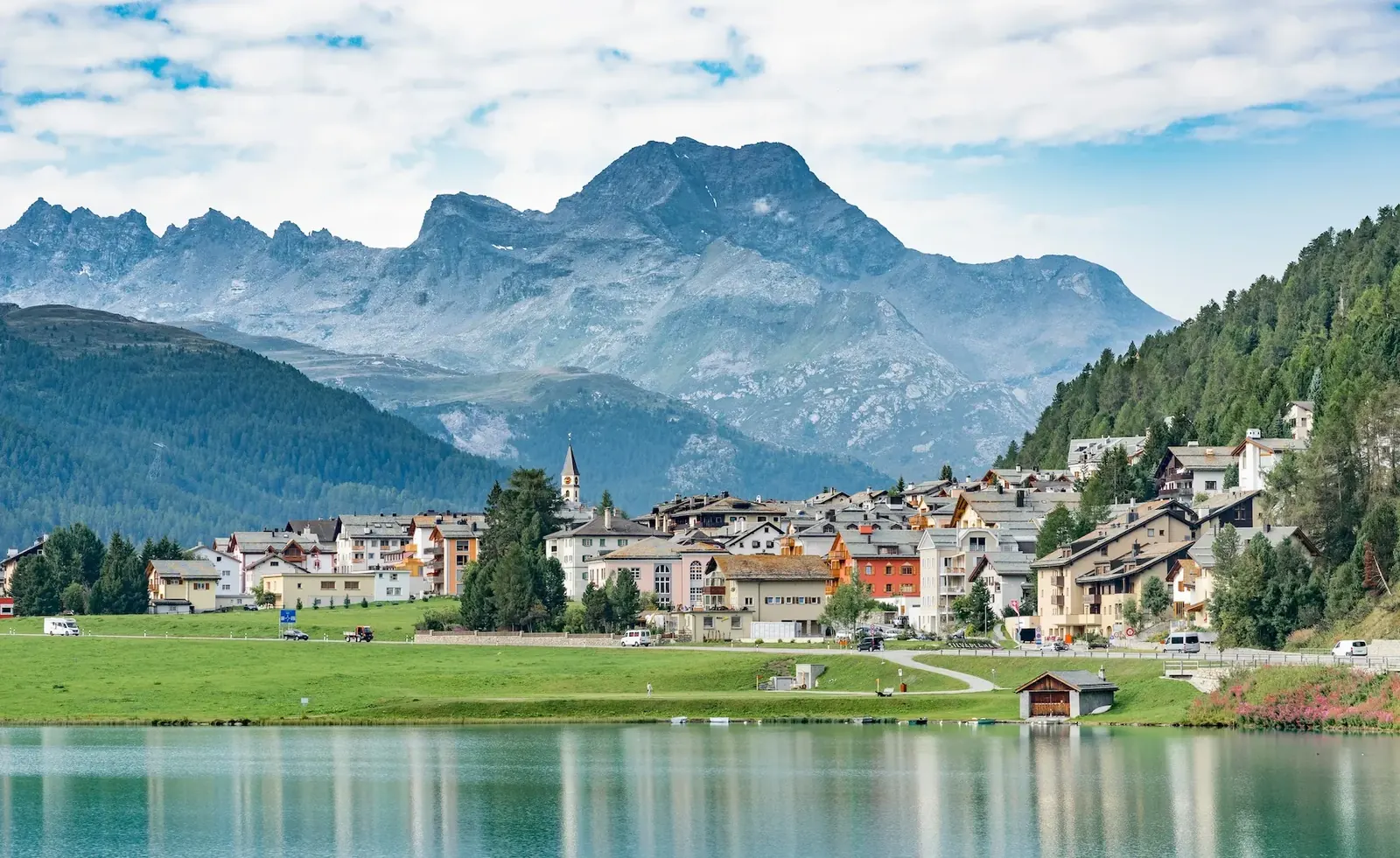
There's a particular kind of clarity that only shows up above 1,700 meters — crisp air, wide-open light, and a sense of scale that makes everything below suddenly feel crowded. Friedrich Nietzsche felt it in Sils-Maria and built philosophy around it. Alberto Giacometti felt it nearby and built sculpture around it. And cyclists riding the Engadin Valley today feel a version of the same thing: a high alpine landscape so spacious and so clear that it seems to slow time down, even while you're pedaling through it.
The Engadin sits high along the upper reaches of Switzerland's River Inn, framed by some of the country's most dramatic peaks. A cycling tour through the region typically links St. Moritz, Sils-Maria, Pontresina, and Scuol, following rivers and lakeshores through terrain that ranges from gentle valley-floor gravel paths to sustained alpine climbs with views in every direction.
A Landscape Defined by Altitude
At elevations well above 1,700 meters (roughly 5,600 feet), the Engadin combines crisp mountain air, abundant sunshine, and a genuine sense of space — wide valley floors, shimmering lakes, and forests of larch and pine, alternating between expansive open stretches and more intimate, sheltered corners. The region enjoys one of the highest sunshine rates in Switzerland, with a high-alpine climate that brings cool, crisp summers, cold winters, and moderate rainfall, aside from the occasional summer thunderstorm rolling through in July and August.
The best cycling window runs from late June to early September, when daytime temperatures turn comfortably mild, though the valley's elevation keeps the air refreshingly cool even at the height of summer. Spring arrives late here — it can still snow into early June — while fall, and September in particular, can be stunning, with golden larch forests and crisp, clear days. That window closes quickly, though: by late fall, the increasing chance of early snow generally brings the cycling season to an end by the close of September.
Villages Built for Mountain Living
Classic Engadin villages are scattered along the valley floor, each blending Swiss tradition with a distinct sense of refined hospitality:
- Sils-Maria — A serene lakeside village long associated with artists and philosophers, and Nietzsche's regular summer retreat. Wide alpine plains, shimmering lakes, and peaceful walking paths define the setting.
- Pontresina — A traditional mountain village set beneath the dramatic Bernina Range, prized for its proximity to glaciers and high-alpine valleys.
- Scuol — The cultural heart of the Lower Engadin, distinguished by its Romansh heritage, mineral springs, and beautifully painted historic houses.
- St. Moritz — One of the world's most famous alpine resorts and the birthplace of winter tourism, blending high-end boutiques and grand hotels with striking lake and mountain scenery.
- Guarda — A beautifully preserved village perched above the valley, known for its decorated façades and its connection to the beloved Swiss children's story Schellen-Ursli.
Two lakes anchor the Upper Engadin landscape: Lake Sils, with calm waters and wide horizons, and Lake Silvaplana, famous for its steady afternoon breeze — known locally as the Maloja Wind — which turns the lake into one of Europe's premier windsurfing and kitesurfing destinations by afternoon, after calm, glassy mornings.
For riders wanting to get closer to the ice itself, Val Roseg offers a broad glacial valley accessible by bike or on foot from Pontresina, following the Roseg River toward open meadows and forest tracks with classic mountain panoramas. Nearby, the Morteratsch Glacier — one of the largest in the Eastern Alps — has a marked trail leading toward its tongue, with interpretive signs tracking its steady retreat over the past century.
And running above and around it all is the Bernina Railway, a UNESCO World Heritage Site whose red trains traverse dramatic alpine terrain between St. Moritz and Tirano, Italy, crossing high passes and stone viaducts along one of the most scenic rail journeys in Europe.
A History Shaped by Altitude and Autonomy
Human settlement in the Engadin dates back to the Bronze Age, with early inhabitants drawn to alpine pastures, water sources, and strategic mountain routes despite the valley's remote, high-altitude setting. Rome never overlooked the region either — in 15 BCE, the Romans incorporated the Engadin into the province of Raetia, building roads over Alpine passes and folding the valley into wider trade networks. That Roman influence left a lasting linguistic legacy: vulgar Latin spoken locally gradually evolved into Romansh, the language still spoken in parts of the valley today.
After Rome's fall, the region passed through Ostrogothic and then Frankish control, gradually integrating into the Carolingian Empire, before coming under the influence of the Bishop of Chur and local noble families between the 9th and 12th centuries — a period that left behind Romanesque churches still standing in the valley. In 1367, the Engadin joined the League of God's House, one of the alliances that eventually consolidated, between 1395 and 1471, into the Free State of the Three Leagues — a federation governing much of present-day Graubünden and establishing a strong tradition of local self-rule that persists in the region's character today. Following the Swabian War in 1499, the Three Leagues aligned closely with the Old Swiss Confederacy, strengthening their independence from Habsburg control.
Economic hardship in the 17th and 18th centuries drove many Engadiners to emigrate seasonally, particularly to Italy and Austria, where they built careers as confectioners, café owners, and merchants. The wealth many of them earned abroad funded the construction of the large, sgraffito-decorated houses that still define the valley's villages. In 1803, under Napoleon's Act of Mediation, the former Three Leagues formally became the Swiss canton of Graubünden, joining the Swiss Confederation.
The Engadin's modern identity as a tourist destination has a surprisingly specific origin story: in 1864, St. Moritz hotelier Johannes Badrutt wagered that his British summer guests should return in winter, promising sunshine and offering to cover their travel costs if they were disappointed. They returned, loved it, and Alpine winter tourism was born on the spot. The 1889 arrival of the Albula railway dramatically improved access and accelerated the region's growth as a resort destination, and by the late 19th century, artists and intellectuals were arriving in numbers — Nietzsche spent summers in Sils-Maria from 1881 to 1888, a period that deeply shaped his philosophy. St. Moritz went on to host the Winter Olympic Games twice, in 1928 and 1948, cementing the Engadin's international reputation. In 1938, Romansh was officially recognized as one of Switzerland's national languages, formalizing the cultural significance of a tongue spoken by relatively few but woven deeply into the region's identity.
Eating at Altitude
Food in the Engadin has always been shaped by elevation, climate, and necessity. Long winters and short growing seasons pushed local cooking toward practicality: potatoes, barley, dairy, and dried meats form the backbone of a cuisine built to sustain people through harsh mountain conditions, even as centuries of outward migration and, later, tourism introduced outside influence and refinement.
A handful of dishes define the regional table:
- Capuns — Perhaps the Engadin's signature dish: small dumplings made from a spätzle-like dough mixed with herbs and sometimes dried meat, wrapped in Swiss chard leaves and gently simmered in broth, then finished with cream and grated cheese. Originally a peasant dish built to use up leftovers, capuns are now a staple on menus throughout the region.
- Maluns — Grated, boiled potatoes slowly pan-fried in butter until they form small golden crumbs, historically a filling, inexpensive meal for farming families, now often served in mountain huts alongside apple purée and Alpine cheese.
- Bündner Gerstensuppe (barley soup) — A hearty starter made with pearl barley, root vegetables, and dried meat, closely tied to the region's agricultural roots and particularly associated with cold-weather sustenance.
- Bündnerfleisch — Air-dried beef, the region's most famous cured product, made possible by Graubünden's dry mountain air and typically served thinly sliced with rye bread and butter.
- Engadiner Nusstorte — The valley's signature dessert: a rich pastry filled with caramelized walnuts and honey or sugar, created in the 19th century by Engadin emigrants who had learned confectionery abroad. Nearly every bakery in the valley makes its own version.
Much of the region's dining happens in alp restaurants and Berghäuser — mountain huts serving simple, hearty fare like soups, cheese, rösti, and sausages, often reachable only on foot or by bike, with panoramic views thrown in at no extra charge.
A Few Local Curiosities
The Engadin carries a handful of details that reward paying attention. Romansh, one of Switzerland's four national languages, is still widely spoken here, particularly around Scuol in the Lower Engadin — one of the last surviving Romance languages north of the Alps, and still visible on local street signs, menus, and greetings despite its relatively small number of speakers.
The valley's distinctive sgraffito houses — thick-walled stone buildings decorated with patterns, dates, and mottos scratched into layers of plaster — mostly date from the 16th and 17th centuries, financed by the wealth of Engadin families who had worked abroad. Their small windows and inward-facing courtyards were built with real purpose: keeping out the long alpine winters.
Each March 1st, the valley celebrates Chalandamarz, a tradition marking the symbolic end of winter, in which children dressed in blue smocks and red caps parade through villages ringing large cowbells and cracking whips to drive winter away. The custom is especially strong in the Lower Engadin and was popularized across Switzerland by the children's book Schellen-Ursli, set in nearby Guarda.
Scuol is home to more than 20 mineral springs, many naturally carbonated, that drew visitors for centuries seeking therapeutic "drinking cures" and bathing — several public fountains in the town's old center still flow with mineral water today, each with a subtly different taste.
Lake Sils, meanwhile, quietly holds a curious distinction: its small scheduled summer boat service makes it one of the highest navigable lakes in Europe with regular passenger traffic — operated by a single licensed vessel, a charming contrast to the grand steamers found on Switzerland's larger, lower-altitude lakes.
And each March, the same landscapes that welcome cyclists in summer transform into the course for the Engadin Ski Marathon, one of the world's largest cross-country ski races, drawing thousands of competitors across frozen lakes and valley floors.
Getting There
Tours typically begin in St. Moritz, most commonly reached by flying into Zurich. Zurich Airport, Switzerland's largest, offers direct flights from most major European cities and numerous non-stop connections from North America, including New York, Los Angeles, and Chicago. From the airport, a train reaches central Zurich in about 15 minutes for under 10 CHF. From there, the journey to St. Moritz runs via Chur — Switzerland's oldest city — aboard the iconic Rhaetian Railway, a narrow-gauge mountain train that climbs through dramatic alpine scenery; the full trip from Zurich takes roughly 3½ to 4 hours, or 2½ to 3 hours by private transfer.
Travelers can also arrive via Milan, flying into Milan Malpensa and connecting by train through Tirano aboard the Bernina Express — itself a UNESCO World Heritage railway — for a longer but genuinely spectacular alternative route into the valley.
Why the Engadin Rewards a Slower Pace
What makes this valley such a compelling place to cycle isn't just the scenery, though the scenery does plenty of the work on its own. It's the particular quality of attention the altitude seems to demand — the same clarity of light and air that drew Nietzsche and Giacometti here a century ago is still doing its work on anyone who spends a day pedaling past Lake Sils or up toward the Morteratsch Glacier.
A train or a car will get you to St. Moritz efficiently enough. A bicycle gets you through the valley itself — past sgraffito-covered farmhouses, along quiet lakeshores catching the first stirrings of the Maloja Wind, and into alp huts serving capuns exactly the way they've been made for generations. In a place this spacious, that slower pace isn't a compromise. It's the entire point.
Read the complete guidebook here.
Ready to plan your tour?
Tell us where you want to go and how you want to ride. We'll send you an itinerary.