

Request a Sample Itinerary
We will send you a sample itinerary which you can further customize as you wish. We will never sell or share your email address with anyone else.
Cycling the Douro Valley: Portugal's Terraced Wine Country by Bike
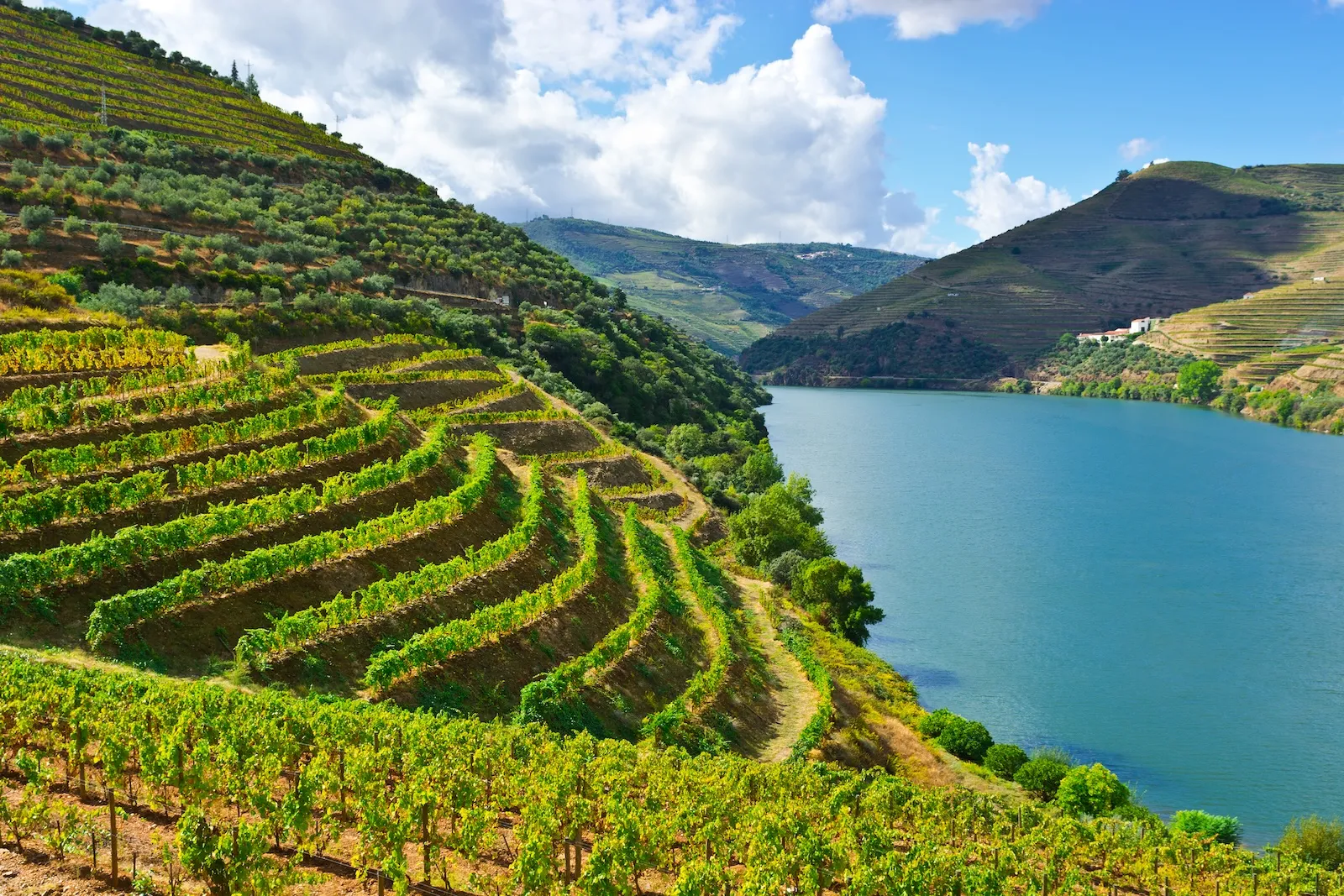
Some landscapes are pretty. The Douro Valley is something else — dramatic, almost sculptural, with terraced vineyards carved into granite hillsides so steep it seems physically improbable that anyone farms them, let alone by hand. This is northern Portugal's wine country, one of the oldest demarcated wine regions on Earth, and a place where a bicycle turns out to be the ideal way to take in a landscape that was, quite literally, built for slow appreciation.
A cycling tour through the region typically links Vidago, Vila Real, Pinhão, and Peso da Régua, tracing quiet lanes that climb and drop along the steep-sided Douro River valley. Along the way, riders pass medieval houses, grand churches, whitewashed villages, and — this being the Douro — an almost constant backdrop of vineyards producing the valley's signature export: port wine.
A Landscape Shaped by Granite and Schist
The Douro Valley has its own microclimate, sheltered from the cold, humid Atlantic winds by mountain ranges along the region's western edge. The result is drier, sunnier conditions than the nearby coast, with colder winters and notably warmer summers — in fact, average summer temperatures here typically run about six degrees higher than in Porto, with roughly a third of the rainfall.
The best riding window runs from March through the end of October, though October can bring some rain and July and August can turn genuinely hot. June and September tend to be the sweet spot: mostly dry and warm without tipping into uncomfortable heat. Spring paints the fields green, while autumn brings the grape harvest — a particularly atmospheric time to visit, with the valley's terraces alive with activity.
The terrain itself tells the story of the region's wine. The soil here is largely schist, a coarse-grained metamorphic rock that makes for punishingly "poor" growing conditions. Combined with the high heat, this forces the vines to work hard for every nutrient, producing grapes that are slow-growing, intense, and complex — a hardship for the vine that turns out to be a gift for anyone drinking the wine afterward.
Spa Towns, River Gorges, and Medieval Villages
The route through the Douro links a handful of towns and villages, each with its own distinct character:
- Vidago — A small spa town famed for its miraculous, medicinally carbonated springs. In the 19th century, it was the most visited spa in Portugal, popular with the royal court, and its waters have been bottled since 1873.
- Chaves — A tranquil spa town on the banks of the Tâmega river with roots dating to Roman times, home to a Roman bridge, a 9th-century castle, and a 12th-century church.
- Vila Real — A compact university town on the Corgo River, carrying real royal heritage in the form of grand 16th- and 17th-century palaces. The river here cuts through a steep-sided gorge with scenic riverside walking trails.
- Pinhão — Known as the true home of port wine, Pinhão sits on a picturesque bend of the Douro River, right in the heart of the UNESCO World Heritage-listed valley. Beyond cycling, the town offers boat and train tours out along the river.
- Peso da Régua — A more understated town at the heart of the Douro Valley, but one with a rich history and some of the region's best restaurants.
- Lamego — Known for its rich cultural heritage, including the ornate Escadas da Nossa Senhora dos Remédios, a monumental staircase climbing to the Nossa Senhora dos Remédios Sanctuary.
Between towns, riders also pass through well-preserved medieval villages like Alijó, notable for its good restaurants, and nearby Sabrosa — birthplace, as it happens, of the explorer Ferdinand Magellan.
Connecting several of these towns are the Eco Routes, a network of cycle paths laid along old railroad lines, staying close to the river and passing a string of old, disused stations — a particularly scenic and gentle way to cover ground.
A History That Rewrote the Map — Twice
Portugal's story stretches back an extraordinary distance: archaeological evidence places Homo Heidelbergensis, an extinct subspecies of early human, in the region as far back as 400,000 years ago. The Romans arrived in 218 BCE, establishing the provinces of Lusitania and Gallaecia across nearly two centuries of conquest, before Rome's decline in 409 CE opened the door to Germanic tribes — the Suebi, Visigoths, and Vandals — who controlled the territory for centuries. In 711, Moorish forces landed in Gibraltar and swept north, taking most of the Iberian Peninsula by 718.
The Christian reconquest began soon after, and by 1139, Afonso Henriques had broken from the Kingdom of Galicia and proclaimed himself King of the new Kingdom of Portugal — the birth of the nation. Southern Portugal was reconquered from the Moors by 1249, and the capital moved to Lisbon in 1255, broadly establishing the country's modern borders.
What followed was one of history's more remarkable expansion stories. In 1415, Portugal conquered Ceuta in North Africa, launching a wave of colonization that would eventually reach Madeira, the Azores, and the Moroccan coast. The 1494 Treaty of Tordesillas divided the largely undiscovered New World between Portugal and Castile along a meridian line — a deal that, among other things, handed Portugal claim to modern-day Brazil. Vasco da Gama sailed around Africa to India in 1497, and by 1509 Portugal had captured Goa, extending its trade empire and spice-driven wealth deep into Asia. For a relatively small European kingdom, Portugal briefly became one of the wealthiest and most far-reaching powers on Earth.
The centuries that followed brought sharp reversals. In 1581, following the death of two kings without heirs, Spain's Philip II claimed the Portuguese throne, unifying the two crowns and stripping Portugal of control over its own foreign policy. Portugal fought its way back to independence in 1640, formally recognized in 1668. A catastrophic earthquake leveled much of Lisbon in 1755, and Napoleon's forces captured the city in 1807, forcing the royal court to relocate — remarkably — to Rio de Janeiro, which served as the official Portuguese capital from 1808 to 1821. Brazil declared its own independence the following year.
The 20th century brought further upheaval: a 1910 coup replaced the monarchy with a First Republic, followed by a 1926 military coup that eventually installed António de Oliveira Salazar as a dictator who ruled from 1932 to 1968 — remaining, despite his fascist politics, neutral throughout World War II. Democracy finally arrived in 1974 with the Carnation Revolution, a peaceful military coup so named because citizens placed carnations in soldiers' rifles to show their support. Portugal's African colonies gained independence the following year, and the country joined the EU in 1986, adopting the Euro in 1999.
Eating and Drinking in the Douro
Portuguese cuisine draws on meats, seafood, vegetables, and legumes, generously seasoned thanks to centuries of spice trade with the East Indies, Africa, and the Americas — piri-piri, saffron, paprika, cinnamon, and nutmeg all make regular appearances, alongside a heavy reliance on garlic, onion, and fresh herbs. Olive oil underpins much of the cooking, and Portugal has developed its own precise classification system for it, graded by acidity from robust cooking oils down to the mildest extra virgin varieties reserved for delicate sauces.
A few dishes are worth actively seeking out on a trip through this region:
- Francesinha — Porto's spectacularly indulgent answer to the French croque-monsieur: bread layered with cured ham, sausage, and steak, blanketed in melted cheese, then drenched in a thick, spicy tomato-and-beer sauce and served over French fries. Invented in 1953 by Daniel David de Silva, it has since spread well beyond Porto.
- Tripas aus molhos — A Vila Real specialty: calf tripe stuffed with cured ham in a spicy white wine and piri-piri sauce, better than the name suggests.
- Toucinho do Céu and Pitos de Santa Luzia — Two of Vila Real's celebrated confectionery traditions, with recipes tracing back to local convents. The first is a rich almond-and-egg-yolk cake; the second, small pastry parcels filled with candied gila, a pumpkin-like squash.
Wine, though, is the valley's true centerpiece. Port wine's origins trace to the late 17th century, when British and Flemish merchants — cut off from French wine by war — began sourcing Iberian wines instead, pushing further inland along the Douro River to find quality. What they discovered, in the rocky hills of the upper valley, were full-bodied, robust wines that traveled poorly on the long journey back to England. The solution was brandy, added to preserve the wine for shipping — and, as a happy accident, to soften its harsher edges. That process still defines port today, though the brandy is now added during fermentation rather than after.
The vines that produce port grapes are famously resilient, thriving in minimal soil and water by sending roots down as far as 30 meters in search of nutrients. Five red grape varieties dominate the region: Touriga Nacional, Tinto Cão, Tinta Barroca, Tinta Roriz, and Touriga Francesa. Fermentation is halted once the wine reaches about 7% alcohol, at which point brandy is added — roughly one part brandy to five parts wine — locking in both sweetness and strength. Port comes in several official categories, but nearly all fall under four broad styles: white, rosé, tawny, and ruby. Beyond port, the region also produces excellent dry reds, typically built around Touriga Nacional, and crisp whites from grapes like Malvasia Fina and Gouveio.
Wineries here are called quintas — rural, wine-producing estates, often centuries old, set in dramatic terraced landscapes. More than 200 dot the Douro Valley, many offering tours, tastings, and, in a number of cases, excellent restaurants of their own.
A Few Local Curiosities
A handful of details add color to a ride through this region. Ferdinand Magellan, born in Sabrosa in 1480, planned and led the 1519 expedition that became history's first circumnavigation of the globe — though Magellan himself was killed partway through, in the present-day Philippines, and never completed the journey he set in motion. Despite the achievement, many of his countrymen considered him a traitor for sailing under the Spanish flag.
Scattered across the countryside are espigueiros — traditional granaries, raised off the ground on stone pillars to keep rodents out and built with slatted walls for ventilation, allowing harvested maize to dry safely through the wet winter months.
The valley is also a haven for birdwatchers, with a river ecosystem supporting grey herons, great cormorants, black-winged kites, and breeding colonies of white storks, alongside otters and the elusive Pyrenean desman. And on the river itself, keep an eye out for rabelos — traditional flat-bottomed cargo boats originally built to ferry port wine barrels downstream to Porto, now repurposed for scenic river tours.
The Portuguese writer Miguel Torga, born Adolfo Correia da Rocha in nearby São Martinho de Anta in 1907, drew heavily on the region's rural landscapes and traditions in his work, which went on to shape Portuguese literature; the town today houses a museum dedicated to his life and writing.
Getting There
Tours typically start in Porto, served by Porto Airport (OPO), with direct flights to major European cities and seasonal service from Newark. Travelers can also fly into Lisbon, which offers more extensive international connections, and take a roughly three-hour high-speed train north to Porto.
Why the Douro Rewards a Bicycle
What makes this valley such a natural fit for cycling is the sheer physicality of the landscape — roads that climb and drop with the terraces themselves, offering constantly shifting views over vineyards stacked improbably up granite hillsides. A car covers the distance. A bicycle earns the view, arriving at each terrace, quinta, and river bend at a pace that actually matches the scale of effort the landscape itself represents — vines fighting for nutrients in poor soil, farmers carving terraces into impossible slopes, centuries of labor concentrated into a single glass of port at the end of the ride.
Read our complete guided here.
Ready to plan your tour?
Tell us where you want to go and how you want to ride. We'll send you an itinerary.