

Request a Sample Itinerary
We will send you a sample itinerary which you can further customize as you wish. We will never sell or share your email address with anyone else.
Cycling North Zealand: Castles, Coastlines, and the Happiest Country on Earth
Some cycling destinations are defined by mountains you have to conquer. North Zealand, Denmark, is defined by the opposite — a landscape so gently rolling, so thoroughly threaded with protected bike lanes and quiet country roads, that the hardest decision most days is which fishing harbor to stop in for lunch. This is a region built almost accidentally for cycling, in a country that consistently ranks among the world's happiest and most bike-obsessed places on Earth.
A tour through this part of Denmark explores Zealand (Sjælland), the country's largest island and home to Copenhagen, though the ride itself stays well outside the capital, weaving through harbor towns like Helsingør and Gilleleje and the quieter coastal village of Tisvilde. Many itineraries also include the option of a day trip across the narrow Øresund Strait into Sweden — a rare chance to cycle through two countries in a single afternoon.
A Landscape Built for Easy Riding
Denmark has a temperate maritime climate, warmed by the Gulf Stream and noticeably milder than its Scandinavian neighbors. Summers are mild, winters relatively moderate, and the weather throughout the year tends toward breezy, with quick swings between sunshine and passing showers. The best cycling window runs from late May to early September, when long daylight hours and comfortable temperatures make outdoor time genuinely pleasant. July and August bring the warmest weather, while May and June often deliver clear skies and crisp air, with fields and gardens in full bloom. Whatever month you visit, it's worth packing waterproofs and a few warm layers — Denmark's maritime climate means most weeks include a mix of everything.
The terrain itself is almost aggressively rider-friendly: rolling hills that rarely exceed 300 feet, set within one of the best cycling infrastructures in the world. Extensive networks of protected bike lanes, quiet country roads, and well-maintained gravel paths make exploring the countryside both safe and genuinely enjoyable — a claim that's easy to make in a brochure and much rarer to actually experience firsthand.
Along the Danish Riviera
The north coast of Zealand has earned the nickname the Danish Riviera, and riding it makes the reasoning obvious: long sandy beaches, relaxed seaside villages, and a summer atmosphere that feels more Mediterranean than Scandinavian, minus the crowds.
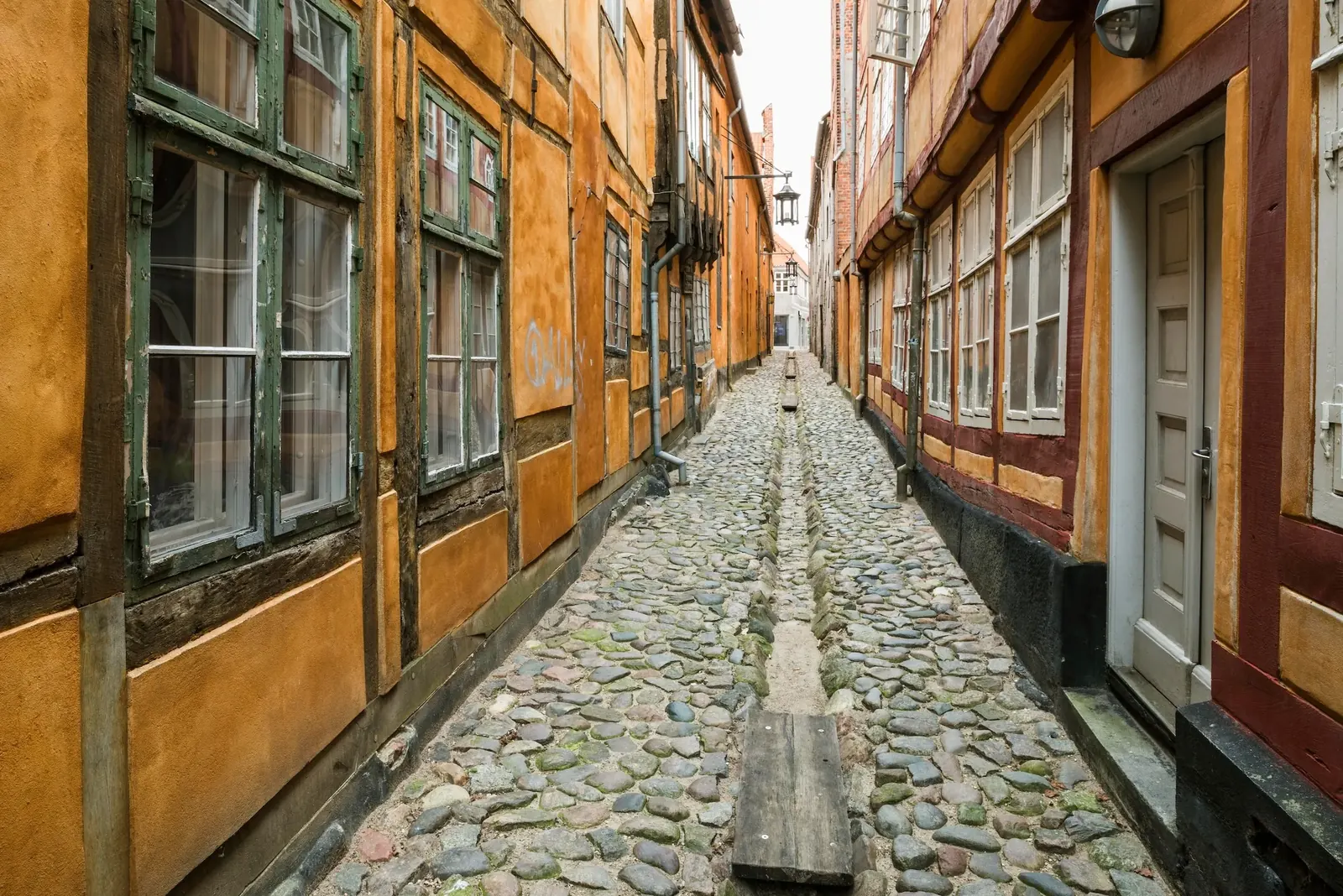
- Helsingør — A historic harbor town crowned by Kronborg Castle, with cobbled streets, maritime museums, and lively waterfront cafés.
- Gilleleje — An authentic fishing village where boats still unload their daily catch into a bustling harbor, paired with sandy beaches and excellent seafood restaurants that capture the relaxed spirit of the coast.
- Tisvilde — A peaceful coastal village ringed by wide sandy beaches and pine forests, known for its wooden summer houses, small cafés, and the nearby Troll Forest. It has drawn artists and summer visitors for generations.
Just outside Tisvilde lies Tisvilde Hegn, home to Troldeskoven, or the Troll Forest — a coastal forest originally planted in the 18th century to halt drifting sand. The result, unintentionally, is one of Denmark's most surreal natural landscapes: wind-twisted pines bent into shapes that look genuinely otherworldly.
Castles Fit for Shakespeare and Royalty
North Zealand was once the seat of Danish royal power, and the castles that remain are some of Northern Europe's finest.
The undisputed star is Kronborg Castle in Helsingør — a UNESCO World Heritage Site and dramatic Renaissance fortress whose imposing walls once controlled ship traffic through the Øresund Strait. It's better known worldwide as the setting for Shakespeare's Hamlet, where the castle appears under the name Elsinore. Shakespeare never actually visited Denmark, but Kronborg's commanding position overlooking the strait made it the obvious stage for one of literature's most famous tragedies.
Nearby, Fredensborg Palace sits on the shores of Lake Esrum, an elegant 18th-century Baroque residence often called the Danish royal family's summer palace. It remains in active use today, surrounded by manicured gardens and sculpture. And in the town of Hillerød, Frederiksborg Castle — one of Denmark's most spectacular — rises from small islands in a lake, its ornate Renaissance halls now home to the Museum of Danish National History, framed by elegant Baroque gardens.
For anyone drawn to detour further, a short 20-minute ferry from Helsingør crosses the Øresund Strait to Helsingborg, Sweden — an easy way to add a second country to a single day's ride.
A History Written by Vikings, Kings, and Tolls
Denmark's story begins earlier than most: the first humans arrived roughly 12,000 years ago as Ice Age glaciers retreated, and by around 4000 BCE, early farming communities were already building the burial mounds and megalithic monuments still visible across the countryside today. The Viking Age, from roughly 800 to 1050 CE, saw Danish seafarers trade, raid, and settle across Europe, cementing Denmark's status as a genuine regional power. In 965 CE, King Harald Bluetooth unified Denmark and introduced Christianity to the kingdom, an event famously commemorated by the Jelling stones.
Between 1100 and 1400, Denmark grew wealthy controlling trade routes across the Baltic Sea, and in 1397 the Kalmar Union brought Denmark, Norway, and Sweden together under a single monarch — at the time, the largest political union in Northern Europe. Denmark's real financial windfall began in 1429, when the crown started collecting the Sound Dues: a toll charged to every ship passing through the Øresund Strait near Helsingør. For more than 400 years, ships were required to stop and pay before continuing into the Baltic, and the resulting wealth was so substantial it helped fund the 1585 construction of Kronborg Castle itself.
Denmark's fortunes shifted in the centuries that followed. Wars with Sweden in 1658 cost Denmark its southern territories and much of its regional influence, and the Napoleonic Wars led to the loss of Norway in 1814, effectively ending Denmark's era as a major European power. In 1849, Denmark adopted a democratic constitution and became a constitutional monarchy. The 20th century saw the country transform into a modern welfare state, prized for social equality and progressive politics — a reputation that persists today, as Denmark consistently ranks among the world's happiest countries and a global leader in sustainability, design, and, of course, cycling infrastructure.
Remarkably, Denmark's monarchy is one of the oldest continuous institutions of its kind anywhere in the world, tracing back to around 935 CE and Gorm the Old. Only Japan's imperial line, founded in 660 BCE, is older; England's monarchy, typically dated to William the Conqueror in 1066, comes in a close third. Today's monarch, King Frederik X, has occasionally been spotted cycling around Copenhagen himself — a fittingly Danish habit for a head of state.
Eating Like a Dane
Traditional Danish cuisine grew out of necessity as much as taste: hearty, simple ingredients built to withstand long winters, drawing heavily on pork, fish, root vegetables, grains, and dairy. Denmark's long coastline and deep maritime traditions mean fish shows up constantly — herring, cod, plaice, and shrimp, most often smoked, pickled, or lightly fried — while rye bread, potatoes, and cabbage round out the traditional table. In recent decades, the country has become an unlikely culinary destination thanks to the New Nordic Cuisine movement, which emphasizes seasonal ingredients, sustainability, and inventive reinterpretations of traditional dishes, visible everywhere from humble seaside cafés to Michelin-starred dining rooms.
A few dishes define the experience:
- Smørrebrød — Perhaps Denmark's most iconic dish: open-faced sandwiches built on dense rye bread and topped with anything from pickled herring and smoked salmon to roast beef or egg, arranged with a level of care that can border on edible art.
- Pickled herring — A centuries-old cornerstone of Danish cooking, preserved in vinegar, sugar, and spices and served cold on rye bread with onion or dill. Curry, mustard, and marinated varieties all make regular appearances, especially around holidays.
- Frikadeller — Traditional Danish meatballs made from ground pork (sometimes blended with veal), pan-fried and served with potatoes, gravy, and pickled red cabbage — pure Danish comfort food.
- Wienerbrød ("Danish" pastries) — Buttery, flaky pastries filled with custard, almond paste, fruit, or jam. Despite the name, the technique actually arrived with Austrian bakers in the 19th century; Denmark simply adopted it and perfected it beyond recognition.
To drink, aquavit — a traditional Scandinavian spirit distilled from grain or potatoes and flavored with caraway or dill — is a fixture of festive Danish meals, served chilled in small glasses and traditionally accompanied by a shouted toast of "Skål!"
Fun Facts Worth Knowing Before You Ride
A handful of details round out the picture of a country that punches well above its weight in cultural export:
LEGO was invented in Denmark in 1932, by a carpenter named Ole Kirk Christiansen in the town of Billund. The name comes from the Danish phrase leg godt — "play well" — and Billund remains home to LEGOLAND, one of the country's most popular attractions.
The Danish flag, the Dannebrog, is believed to be the oldest continuously used national flag in the world. Legend holds it fell from the sky during a 1219 battle in Estonia, inspiring Danish soldiers to victory — true or not, it's proudly displayed across the country to this day.
Denmark's reputation as the happiest country in the world is often tied to the concept of hygge — coziness, comfort, and the simple pleasure of good company, whether that means candlelight and warm food on a long winter evening or a relaxed lunch after a day on the bike.
The country's cycling culture isn't just infrastructure — it's cultural bedrock. In Copenhagen alone, there are more bicycles than cars, and nearly half of all residents commute by bike. It's little wonder the country is regularly cited as one of the safest and most enjoyable places in the world to ride.
Just north of Copenhagen sits Bakken, the oldest operating amusement park in the world, dating back to 1583, when visitors first gathered around a natural forest spring and entertainment slowly grew up around it. And each June 23rd, Danes celebrate Sankt Hans Aften (St. John's Eve) with bonfires on beaches and lakeshores nationwide — traditionally topped with a straw witch, symbolically sent flying off to Germany to mark the arrival of summer.
Practically speaking, travelers rarely hit a language barrier here: Denmark consistently ranks first or second in the world for English proficiency among non-native speakers, and English is taught from an early age in Danish schools. And the country's design legacy runs deep — furniture and lighting from Danish designers like Arne Jacobsen, Hans Wegner, and Poul Henningsen continues to shape interiors around the world nearly a century after they were first sketched.
Getting There
Tours typically start in Copenhagen, served by Copenhagen Airport (CPH), the largest in Scandinavia, with direct flights from most major European cities and numerous North American hubs including New York, Los Angeles, Chicago, and Boston. The airport sits just five miles from the city center, with frequent trains and metro connections reaching Copenhagen Central Station in about 15 minutes for around 36 DKK (roughly $6) per person. Taxis take a bit longer — 20 to 30 minutes depending on traffic — and typically run 250 to 350 DKK ($40 to $55).
Why North Zealand Rewards a Bicycle
What makes this corner of Denmark such a natural cycling destination isn't just the flat terrain and world-class bike infrastructure, though both help enormously. It's the way the landscape itself seems designed for the unhurried pace a bicycle demands — a coastline made for stopping at fishing harbors, castles positioned exactly where a rider would want a reason to pause, and a national culture that treats cycling not as recreation but as simply how people get from one place to the next.
A car would get you between Kronborg Castle and the beaches of Tisvilde efficiently enough. A bicycle gets you through the fishing villages, the wind-shaped pines of the Troll Forest, and the quiet country roads in between — which, in a country that has spent centuries perfecting the art of hygge, is really the whole point.
Find the complete guidebook here.

Ready to plan your tour?
Tell us where you want to go and how you want to ride. We'll send you an itinerary.