

Request a Sample Itinerary
We will send you a sample itinerary which you can further customize as you wish. We will never sell or share your email address with anyone else.
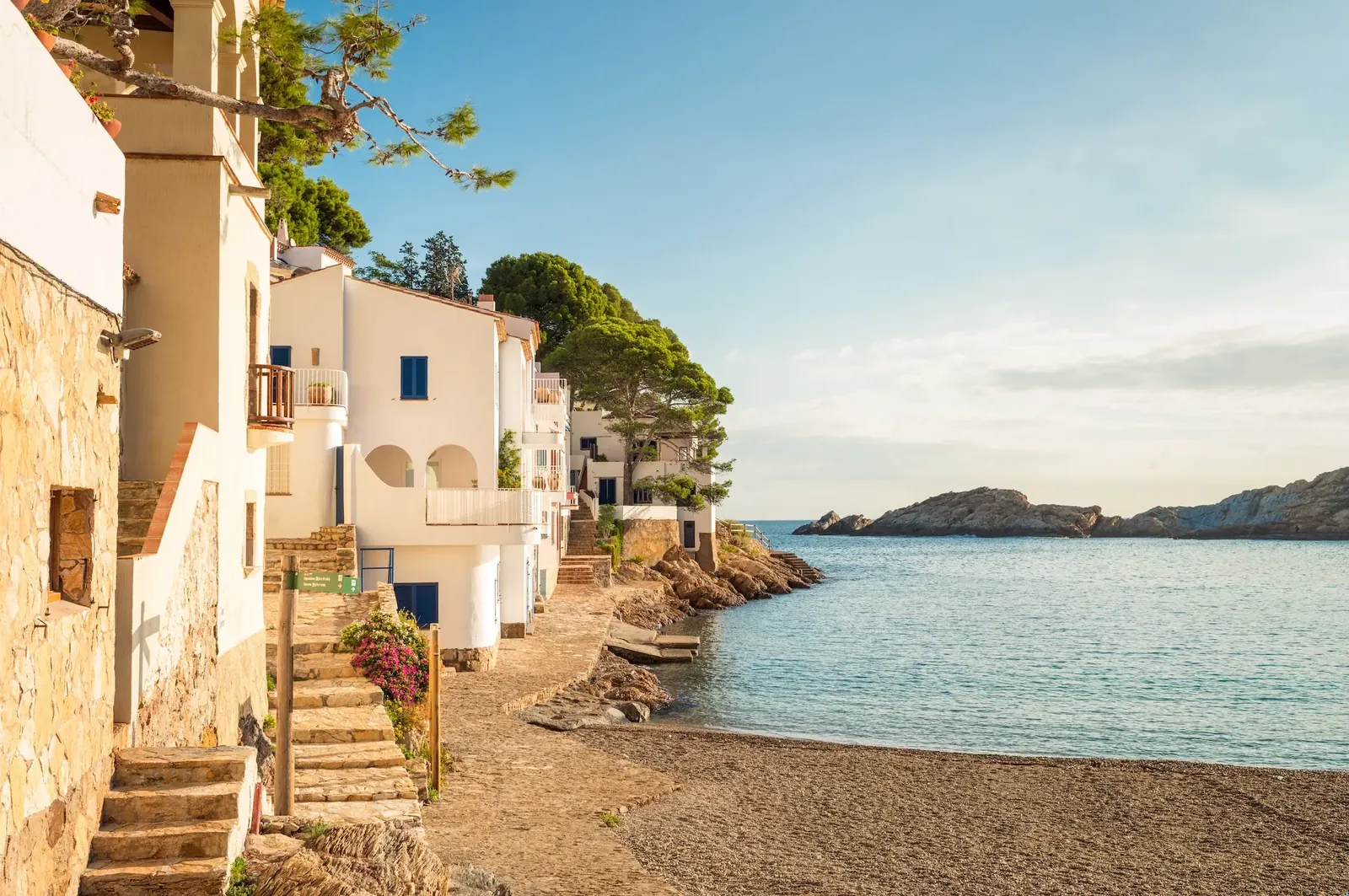
Pedaling Through Catalonia: Volcanoes, Medieval Villages, and the Best Reason to Skip the Beach Chair
There's a version of Spain that most travelers never see — not because it's hidden, but because it moves too fast past a car window. It's the Spain of dormant volcanic craters turned into hiking trails, of walled medieval cities where professional cyclists warm up before a Grand Tour, and of small coastal towns where the harshest decision of the day is which seafood stew to order for dinner. That Spain is Catalonia, and the best way to experience it is from the seat of a bicycle.
A cycling tour through this corner of northeastern Spain typically links three very different bases — Olot, Girona, and the twin coastal towns of Llafranc and Calella de Palafrugell — stitching together volcanoes, rivers, vineyards, and the rugged shoreline known as the Costa Brava. Here's what makes the region worth exploring at bicycle speed.
A Landscape Built by Fire, Water, and Time
Catalonia's geography does a lot of the storytelling for you. The region sits in a Mediterranean climate zone, shielded from Atlantic weather by mountains to the west, which means warm, dry summers and mild winters. Spring is widely considered the sweet spot for cycling here — comfortably warm with fewer crowds — while July and August push riders into early starts and late finishes to dodge the midday heat. By the time September rolls around, temperatures ease again, and good riding weather generally holds through the end of November.
The most distinctive feature of the landscape, though, is volcanic. Inland sits Olot, nicknamed "the city of volcanoes," which anchors the Garrotxa Volcanic Zone Natural Park. More than 40 volcanoes dot this zone — the youngest on the entire Iberian Peninsula. Eruptions here began roughly 350,000 years ago, and the most recent activity was a mere 11,000 years ago, which in geological terms is essentially yesterday. Centuries of forest and farmland have since reclaimed the craters, and today they make for some of the most unusual cycling and hiking terrain in Europe.
Olot itself is ringed by four dormant volcanoes — Montsacopa, Montolivet, Garrinada, and Bisaroques — two of which are easy to visit. The climb up Volcà del Montsacopa is a particular favorite: a gentle ascent to a 510-metre summit that rewards you with panoramic views over the Pyrenees, plus, rather charmingly, a small church and a café tucked inside the crater itself. Beyond the volcanoes, Olot's old town is a tangle of narrow streets and elegant squares, with 19th-century mansions along Passeig de Barcelona that recall the town's textile-industry prosperity.
Girona: Where Cyclists Actually Live
If Olot is the geological centerpiece, Girona is the cultural and cycling heart of the region — quite literally. Split by a river, the city pairs an ancient walled old town, complete with a cathedral and a well-preserved Jewish quarter, with a livelier "new" town of museums, boutique shopping, and leafy squares.
Girona's Cathedral of Santa Maria has a claim to fame that's easy to miss at a glance: it holds the widest Gothic nave in the world. Nearby, the Peixateries Velles Bridge — better known as the Red Iron Bridge — was designed by none other than Gustave Eiffel, decades before his tower went up in Paris.
But ask any serious road cyclist about Girona and they'll likely light up for a different reason. The city has become something of a secret headquarters for the professional peloton. Rolling country lanes, testing climbs, and technical descents in the surrounding hills have drawn a disproportionate number of professional cyclists to live and train here relative to the city's modest population. It's not unusual to spot a pro sipping coffee at a Girona café between training rides — proof, if any were needed, that this is genuinely excellent cycling country, not just scenic countryside.
Girona also happens to be a serious food destination. The region counts more than 60 Michelin-starred restaurants, and one of the most celebrated, El Celler de Can Roca — run by the Roca brothers — has earned three stars and a global reputation to match.
The Coast: Rugged by Name, Rugged by Nature
Ride east toward the Mediterranean and the landscape changes again. This stretch of coastline is the Costa Brava — literally "rugged coast" — and the name is not an exaggeration. Cliffs plunge into hidden coves, and small fishing villages cling to the shoreline in a way that feels more like a postcard than an itinerary stop.
Two adjacent towns, Llafranc and Calella de Palafrugell, capture the coast's dual personality. Both have sandy beaches and whitewashed buildings, but Llafranc leans toward understated elegance while Calella retains more of its working fishing-village character. A scenic coastal path, the Camí de Ronda, links the two bays and makes for one of the most photogenic short rides — or walks — in the region. History runs even deeper here than the architecture suggests: nearby sits the Poblat Ibèric de Sant Sebastià de la Guarda, a settlement originally inhabited by the Indigetes, an Iberian tribe that occupied this stretch of coast well over two thousand years ago.
A History Worth Knowing Before You Ride Through It
Catalonia's identity is inseparable from a long and often turbulent history, and understanding even the outline of it changes how the landscape reads as you pass through. The short version: this land moved through Roman, Visigothic, and Moorish control before being absorbed into Charlemagne's empire as a buffer zone known as the Marca Hispanica in the 9th century. In 1137, the County of Barcelona united with the Kingdom of Aragon, forming the Crown of Aragon and turning Catalonia into a genuine Mediterranean power.
Centuries of shifting alliances followed — including a 17th-century rebellion against the Spanish crown and, in 1714, the fall of Barcelona to Bourbon forces, a date still commemorated today as Catalonia's national day. The 19th century brought industrialization and the Renaixença, a cultural revival of the Catalan language. The 20th century brought autonomy, civil war, decades of suppression under Franco, and eventually a return to self-government in 1979. Catalonia remains, to this day, one of Spain's wealthiest and most culturally distinct regions, with an ongoing political conversation about independence that shows no signs of quieting down. You don't need a history degree to enjoy a ride through Girona's old town, but knowing that its walls have witnessed Romans, Moors, and medieval kings adds a layer that a guidebook map alone can't provide.
Eating Your Way Across Catalonia
If there's a rival to the scenery for a cyclist's attention, it's the food. Catalan cuisine draws on both mountain and coastal traditions, blending meats — pork, lamb, poultry, game — with abundant seafood like anchovies, prawns, squid, and clams, alongside seasonal vegetables and legumes. Centuries of trade with France, Italy, North Africa, and the Middle East left their mark too, in the form of saffron, paprika, cinnamon, and nutmeg woven through otherwise rustic dishes.
A few specialties are worth specifically riding toward:
- Calçots — tender, sweet spring onions somewhere between a leek and a scallion, grilled over open flame, wrapped in newspaper to steam, then peeled and dipped in a nutty, garlicky romesco sauce. Eating them properly requires an apron, raised elbows, and a sense of humor.
- Escudella i carn d'olla — considered Catalonia's national winter dish, a hearty stew of meats, vegetables, beans, and potatoes traditionally served in stages: broth first, then meats, then vegetables.
- Crema catalana — a custard dessert dating to medieval times, lighter than its French cousin crème brûlée, finished with the same brittle caramelized-sugar crust.
- Pa amb tomàquet — the simplest possible Catalan staple: rustic bread rubbed with ripe tomato and olive oil, served alongside cured meats and cheese.
- Suquet de peix — a fishermen's stew from the Costa Brava built around the day's catch, simmered with potatoes, tomato, garlic, saffron, and almonds.
Wine has an equally long pedigree here — over 2,500 years, starting with Greek vineyards near Empúries and expanded under Roman rule. The DO Empordà, one of Catalonia's most historic wine appellations, stretches from the Pyrenean foothills to the Costa Brava coastline. And no regional food story is complete without Cava, Catalonia's answer to Champagne. Made using the same traditional method but from a distinct trio of grapes — Macabeo, Parellada, and Xarel·lo — Cava production runs to roughly 240 million bottles a year, making the region Spain's sparkling wine powerhouse.
Beyond the Bike: Dalí, Human Towers, and Chocolate
A few cultural threads round out the picture of Catalonia, and they tend to surface in conversation whether you're looking for them or not.
Salvador Dalí was born in Figueres in 1904, and the region still orbits around his legacy. The self-styled "Dalí Triangle" links three sites tied to the surrealist master: the Dalí Theatre-Museum in Figueres, his former home in Portlligat, and the Gala Dalí Castle in Púbol — each offering a different angle on his eccentric world.
Then there are the castells, or human towers — a Catalan tradition recognized by UNESCO for its cultural significance. These towers can reach up to ten stories high, built with remarkable teamwork and trust across generations, with children often forming the topmost, lightest levels.
And for anyone with a sweet tooth, Barcelona holds a surprising claim: it was home to Europe's first chocolate-making machinery, imported from the Americas in the 16th century. The city still celebrates that legacy with chocolate museums, artisanal chocolatiers, and an annual chocolate festival — all the justification you need for a post-ride plate of churros dipped in thick, dark chocolate.
A Few Practical Notes for Planning a Trip
Most cycling trips through this region start in either Girona or Figueres, both reachable in under an hour from Barcelona-Sants railway station via Spain's fast AVE rail service. Girona's train station sits close enough to town that walking to most hotels is easy; Figueres is a short taxi ride from its station to the town center.
A handful of practical details are worth knowing before you go. The currency is the Euro, and while Visa and Mastercard are widely accepted in restaurants and hotels, smaller food shops sometimes prefer cash, and American Express isn't as reliably taken outside major hotels and car rental agencies. ATMs — commonly called "cash machines" — are easy to find in every overnight town and most towns along the way, though it's worth checking with your bank about foreign transaction fees before you leave, which can range anywhere from nothing to over three percent.
Electricity runs at 220 volts on Type F (Schuko) sockets, compatible with Type C and E plugs as well — a departure from North America's 110-volt system, so pack a plug adapter and double-check that chargers and any electronics are rated for the higher voltage (most phone and laptop chargers are; hair dryers often aren't). Wi-Fi is common in hotels and restaurants, though you may need to ask staff for the access code, and it's frequently available for free in tourist offices and other public spaces too.
Why Catalonia Works So Well by Bike
What ties all of this together — the volcanoes, the Roman ruins, the Michelin stars, the rugged coastline — is scale. Distances between towns are short enough to link comfortably by bicycle, but varied enough that each day's ride feels like arriving somewhere genuinely new. Rolling inland lanes give way to coastal descents; medieval old towns give way to volcanic craters; quiet countryside gives way to a city where the local café crowd might include a professional cyclist between training rides.
It's a region built, almost accidentally, for exploring slowly and under your own power — which is exactly the point. A car gets you between the highlights. A bike gets you through everything in between, and in Catalonia, everything in between is usually the best part.
Download complete guide here.
Ready to plan your tour?
Tell us where you want to go and how you want to ride. We'll send you an itinerary.